
Guide
When to visit Etna, season by season
By Edy · Updated · 16 min read
You can visit Etna all year round: the quad in the woods and trekking up to 3,000 m run in every season, while the summit craters at 3,400 m are usually visited from June to August. The right time depends on what you want to do; whether you go up, and how far, is down to the weather and the volcano's activity on the day.

It's one of the first things people ask me when they get in touch. There's no wrong time to come to Etna as such: what changes is what you can do and how you need to prepare. In this guide I'll go through it season by season and month by month: what to expect up high and which excursion makes most sense, so you can choose your dates with a clear idea of what's ahead.
Etna's seasons, one by one
On Etna the seasons don't keep pace with those on the coast. It can already be summer in Catania while snow lingers up high, and in the middle of August you might need a jacket at 3,000 m. So whenever you think about the season, think about the altitude too.
Spring (March–May)
Spring is a season of transition, and on Etna you can really see it. Lower down, the woods turn green again and the days get longer; higher up, winter can hang on for a long time, with patchy snow and a cold wind, especially in March and April.
- Quad: a good time. In the woods on the south side it's usually pleasant, and there are fewer people than in summer. You'll find all the details on the quad in the woods page.
- Trekking at 3,000 m: it runs, but the route and altitude depend on how much snow is left and on the wind. The closer you get to May, the more conditions tend to improve, with no guarantees.
- Summit craters: usually not yet. Their season generally starts in June.
If you come in spring, bring a warm layer anyway: in these months you really feel the difference between the sea and the mountain.
Summer (June–August)
Summer is the most complete season: it's the time when, usually, all three excursions are possible, summit craters included. It's also the busiest season.
- Quad: it's more pleasant among the trees than in the city, and on request you can also do it at sunset, when the season allows.
- Trekking at 3,000 m: the snow has generally gone and you walk on ash trails. The sun up high is strong, though, and the wind can be cold even in July. Here's what the trek up to 3,000 m is like.
- Summit craters at 3,400 m: this is their time, usually from June to August. You go up in small groups of 10–12 people, and only if the weather and volcanic activity allow it that day. Everything you need to know is on the summit craters excursion page.
Something I see a lot: people arrive at the cable car station in shorts and a T-shirt because it's hot down below. Up high the temperature is a different story, and for the quad and the craters you need long trousers anyway. Remember too that trekking and the craters aren't suitable for anyone with heart or breathing problems, in any season.
Autumn (September–November)
Autumn is the time I recommend to anyone looking for more peace and quiet. September is often still mild, and there are fewer people than in August; from October the weather becomes more changeable and the first really cold days arrive up high. In November the first snow can appear on the upper slopes.
- Quad: a lovely time for the woods, with a different light from summer. The days are getting shorter, though, so choose your start time accordingly.
- Trekking at 3,000 m: it runs, with an extra eye on the forecast. Wind and cloud become more frequent, and how far you get is decided on the day.
- Summit craters: after August you usually can't go up any more. There are exceptions, but they can't be predicted: don't count on them when you plan your trip.
Winter (December–February)
In winter Etna shows a different face. Snow can cover the upper part of the volcano and come down as far as the cable car station, the days are short and it's seriously cold up high, with a wind you really feel. In return there are fewer people, and on clear days you see the snow-covered volcano, a view you don't get in summer.
- Quad: it runs all year round, winter included. With heavy rain, snow on the route or wind, whether to set off is assessed on the day.
- Trekking at 3,000 m: it also runs in winter, but this is the season when conditions matter most. The route and altitude are adapted to the snow and wind, and sometimes you may have to give up.
- Summit craters: no, they're not a winter excursion.
If you come in winter, the most important thing is flexibility: keep more than one day free and write to me beforehand, so we can look together at how the week is shaping up.
Month by month
Here's a month-by-month summary. Take it as general guidance, not a forecast: every year is different, and what really counts is the day you go up.
| Month | What to expect up high | Best-suited excursions |
|---|---|---|
| January | Deep winter: cold, wind, frequent snow up high | Quad; trekking depending on conditions |
| February | Still winter, short days, snow possible lower down too | Quad; trekking depending on conditions |
| March | Changeable weather, snow still lying up high | Quad; trekking depending on conditions |
| April | Longer days, cold and patchy snow up high | Quad, trekking |
| May | Mild lower down, cool up high, snow may linger at the top | Quad, trekking |
| June | Start of summer: strong sun, cool air up high | Quad, trekking; craters if conditions allow |
| July | Hot down below, cool and windy up high | Quad, trekking, craters depending on conditions |
| August | The busiest month; afternoon cloud and storms possible | Quad, trekking, craters depending on conditions |
| September | Often still mild, fewer people | Quad, trekking |
| October | More changeable weather, first cold days up high | Quad, trekking |
| November | Cold up high, first snow possible | Quad; trekking depending on conditions |
| December | Winter: cold, wind, snow possible | Quad; trekking depending on conditions |
Two things to bear in mind when reading the table. First: ‘all year round’ means the excursion has no closed season, not that it goes ahead in any weather. Second: the summit craters have a narrower window, and even within that window there are days when you can't go up.
The weather up high
In the mountains it isn't enough to know what the weather's like in Catania or Nicolosi: what happens at 3,000 m can be very different. To make sense of it, you only need three things: the temperature dropping as you climb, the wind and the clouds.
The higher you go, the colder it gets
On average, in the lower part of the atmosphere the temperature drops by about 6.5 °C for every 1,000 m of altitude. It's an average figure that in reality varies with the day, the time and the weather, but it gives you an idea. From the coast to 3,000 m, that works out at about 20 degrees less. From the cable car station, which sits at about 1,900 m, up to 3,000 m it's about 7 degrees less, and to the craters at 3,400 m around ten.
In practice: if it's 30 degrees in the city, you may find around ten up high, and with the wind it feels colder still. In winter, by the same calculation, it can drop below zero up there.
The wind
The wind is what surprises first-timers most. Above the tree line there's no shelter, and up high the wind can be strong and cold even on a sunny day. It's also one of the reasons why on some days the decision is made not to go all the way up: with strong winds the day's plans can change, and that includes the cable car.
Cloud and fog
On Etna clouds form and move quickly. You might set off in sunshine and find yourself inside a cloud shortly afterwards, or climb above the cloud layer and see it beneath you. In fog, visibility drops, you feel the cold more and the view disappears: that's another reason why it's sometimes better to wait or choose another day.
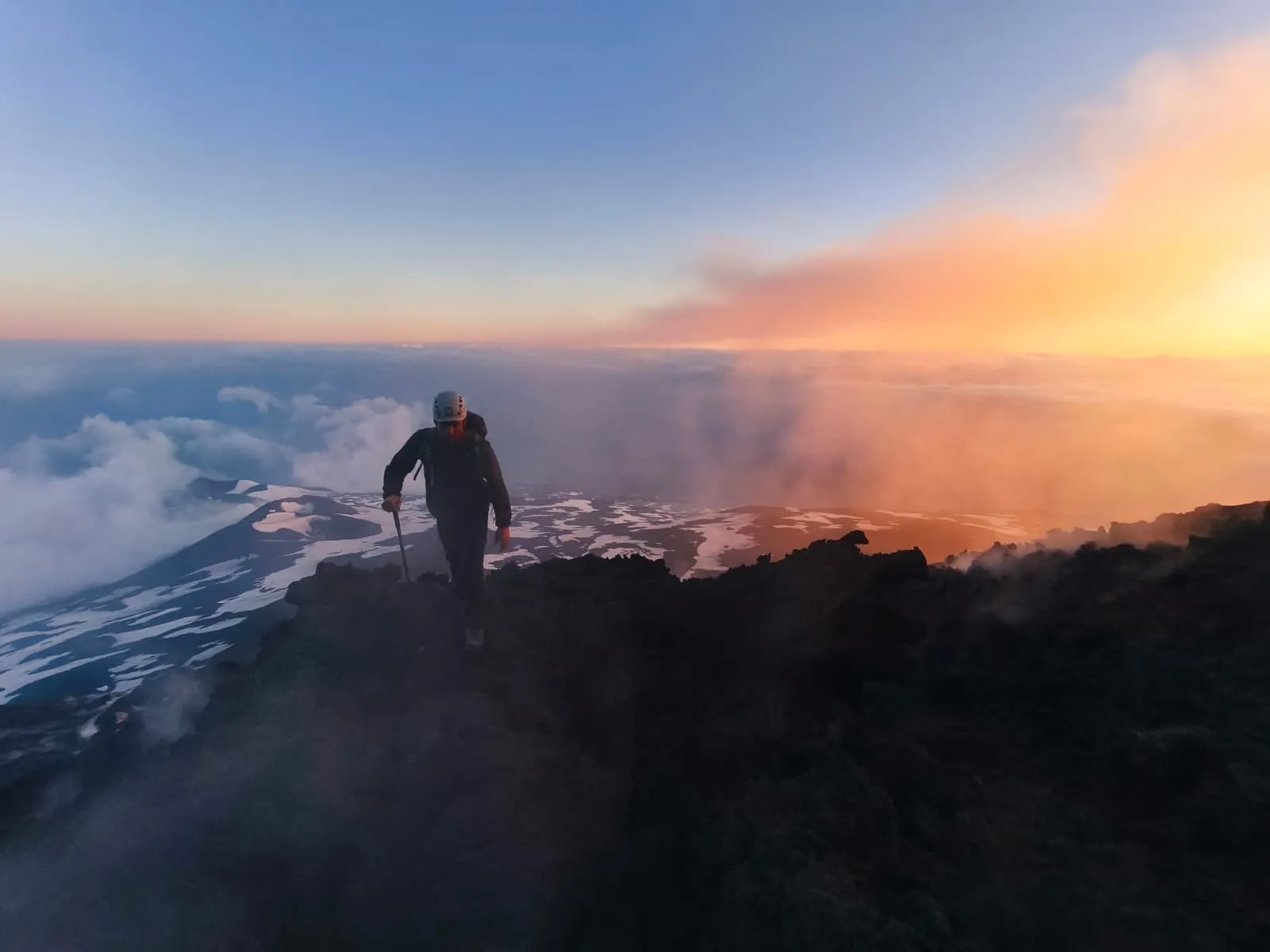
This photo shows two things clearly: the clouds below the ridge and the patches of snow left on the slopes. Up high, the seasons don't match those by the sea.
Why it changes so fast
Etna is a very high mountain close to the sea. Moist air rises up the slopes, cools and forms clouds, while the wind changes direction and strength with altitude. The result is that up high the weather can change in a short time, even when the forecast for the coast is good.
That's why the forecast remains the only reliable source, but you need to check it for the altitude and close to the day. Nobody can promise you in advance what the weather will be like at a specific time.
How to read the forecast
When you check the forecast for Etna, don't stop at the sun or rain icon for the city. For the excursion, other things matter:
- Altitude: look for the mountain forecast, not the one for Catania or the town where you're staying.
- Wind: up high it matters more than the temperature, both for the cold and for safety.
- Cloud: overcast skies up high mean little view and more cold, even without rain.
- Timing: the most useful forecasts are the ones from the day before and from the morning itself; those from a week earlier only give you a rough idea.
If you write to me the day before, I'll tell you what the forecast says for up high and we'll decide together.
Snow and winter
Snow on Etna in winter is normal, and up high it can last a long time. It's also the thing that varies most from one year to the next.
When and where the snow falls
The first snowfalls up high generally arrive in autumn, and on the highest parts patches of snow can linger well into spring. On the coldest days it can also come down as far as the cable car station and lower. How much snow falls, and when, can't be known in advance, though: there's no date that guarantees snow, and no date that guarantees there won't be any.
What changes for the excursions
- With snow, the trek adapts: the most suitable route is chosen and how far to go is decided on the spot. It takes more effort and more care, and you don't always reach the same altitude as in summer.
- The quad remains the easiest excursion to do in winter, but here too rain, snow and ice on the route matter: it's assessed on the day.
- The summit craters aren't done in winter.
If you've seen photos of snow-covered Etna and want to walk in the snow, write to me: I'll tell you honestly whether it's realistic on the days you have in mind.
Volcanic activity: why lava can't be scheduled
Etna is an active volcano, and you can tell: a plume of gas and steam often rises from the craters, and every so often there are phases of more intense activity. It's one of the reasons so many people come here, and it's also why nobody can tell you days in advance what the volcano will do.
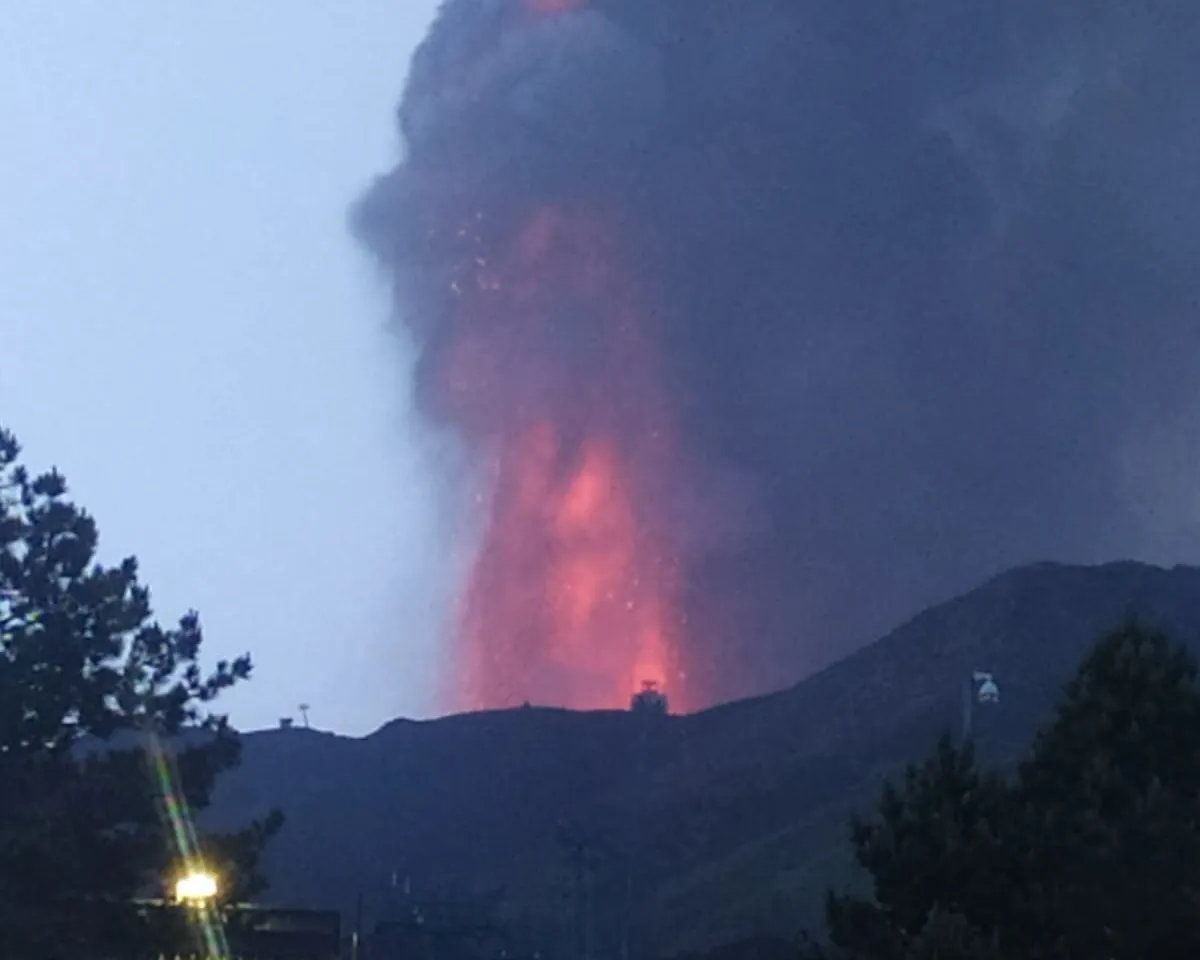
This is a lava fountain seen from a distance. Moments like this aren't announced weeks ahead and can't be booked: when activity is this intense, you keep your distance and nobody goes up high.
Why it can't be planned
Etna's activity changes from one day to the next, sometimes from one hour to the next. The volcano is monitored day and night by INGV's Etna Observatory, which publishes updates and bulletins on its activity: this is valuable information, but it describes what's happening now, not what will happen next week.
The summit changes too: with eruptions the craters grow or collapse, and their height isn't the same from one year to the next. That's why the high-altitude routes aren't always the same.
What it means for your day
- You rarely see lava, and only when safety conditions allow it. I can't promise it, and be wary of anyone who guarantees it.
- Whether you go up, and how far, is decided by the conditions on the day: weather and volcanic activity together. The choice is made on the spot, on the day.
- If activity increases, it may be that nobody goes up high, or not as high. In that case the quad in the woods, which doesn't head towards the summit, is an alternative we can look at together.
- Don't choose your date based on news from a week before: write to me close to your departure and I'll tell you what the situation is.
What time of day is best
We agree the exact times when you book, because they depend on the season and the excursion. Here I'll explain the logic, so you know what to ask.
Also work out how much time you need: the quad takes 1.5–2 hours, while for trekking and the craters the duration depends on the day's route. Ask me when you book, and don't plan anything else straight afterwards.
Morning
If you can choose, I recommend the morning for going up high. The air is often clearer in the early hours, while during the day clouds can climb the slopes and cover the view. Setting off early also gives you more margin if the weather changes and, in summer, means walking in less heat for the first part of the climb.
Afternoon
You can still go up in the afternoon, but you're more likely to find cloud up high, especially in summer, when storms can also form. If you only have the afternoon free, the quad in the woods is often the simplest choice: among the trees, cloud up high affects the experience less.
The quad at sunset
The quad can also be done at sunset, on request, when the season allows. The light among the trees changes and the air cools down: bring an extra layer, because the temperature drops quickly after sunset. Dates and times depend on the time of year, so ask me when you write.
How to choose your date
Once you've worked out the period, you still need to choose the day. This is where experience counts for more than the forecast.
Keep a spare day
The most useful advice I can give you is this: if you can, don't put the excursion on the last day of your holiday. If the weather or the volcano doesn't allow it on the day you've chosen, having a free day afterwards gives you the chance to try again instead of giving up.
- Put the excursion at the start of your stay, not at the end.
- Leave at least one free day afterwards, as a back-up.
- For the summit craters, which depend more on the conditions, that margin matters even more.
- If you only have a few days, write to me: I'll tell you which excursion is most likely to go ahead in that period.
If you can't go up on the day
It happens, and it's part of the volcano. On the day, we'll talk and I'll explain the situation: sometimes it's enough to change the time, sometimes you don't go as high, sometimes it's better to change day or choose another excursion. What I'll never advise you to do is go up high when the conditions aren't right, even if you've travelled a long way to get here. Ask me how a change of date works when you book: I'll tell you straight away, so there are no surprises.
Crowds and quieter periods
August is generally the busiest month, along with public holidays, long weekends and fine-weather weekends. On those days there are more people at the cable car station, and the places for the craters, which run in groups of 10–12 people, fill up sooner.
If you'd like things quieter:
- Choose weekdays over weekends.
- For the craters, if you can, consider June or July rather than August.
- For the quad and trekking, spring and autumn are usually the quietest times.
- In winter there are generally fewer people on weekdays, but you need more flexibility with your date.
When to write to me
Tell me your dates as soon as you know them: I'll confirm availability and send you a quote. In the busiest periods it's best to get in touch early, and for the summit craters in summer write to me as soon as possible, because the groups are small. If you're coming by car or bus, the guide on getting to Piazzale Funivia has directions and tips on timing.
What to bring for each season
We provide most of the gear: for the quad, a helmet, hygiene cap, windproof jacket and gloves; for trekking and the craters, a helmet, shoes, socks, poles and a small backpack. What's left to you is mainly your clothing, which changes with the season. You'll find everything in detail in the guide on what to bring on Etna; here are the essentials.
- Always: long trousers, layers and water. For the quad, closed-toe shoes.
- In summer: sun cream, sunglasses and a hat, plus a warm layer and a windproof jacket for up high. The sun is stronger up there.
- In spring and autumn: an extra warm layer and a jacket that keeps out the wind and rain.
- In winter: properly warm clothing, a beanie, gloves for trekking and a waterproof jacket. If there's snow, I'll tell you what else you need.
My advice
If I had to sum it all up in a few lines: choose what you want to do first, then the period.
- Want to reach the summit craters at 3,400 m? Come between June and August, keep a spare day and write to me early.
- Want to walk up high on the ash trails? Trekking at 3,000 m runs all year round: it's easier in summer, spring and autumn, while winter calls for more flexibility.
- Short on time, or travelling with children aged 6 and over? The quad in the woods runs in every season, and at sunset on request.
High-altitude excursions aren't suitable for anyone with heart or breathing problems: in that case, let's talk first and look at the quad together. Everything about who can go up and when excursions set off is in the guide on safety on Etna.
Write to me with the dates you have in mind, how many of you there are and everyone's ages: I'll tell you what makes sense to do at that time of year and send you a quote. You'll find me on the contact page.
Frequently asked questions
What's the best time to visit Etna?
It depends on what you want to do. The quad and trekking at 3,000 m run all year round; the summit craters at 3,400 m usually from June to August. Either way, the conditions on the day decide.
Can you visit Etna in winter?
Yes. The quad and trekking also run in winter, if conditions allow. With snow and wind, the route and altitude are decided on the spot, on the day. The summit craters aren't done in winter.
When can you go up to the summit craters at 3,400 m?
Usually from June to August, with some exceptions, and only if the weather and volcanic activity allow it. The decision is made on the spot, on the day.
Can I pick a date to see lava?
No. The volcano's activity changes from day to day and you rarely see lava, only when safety conditions allow it. I can't promise it.
How cold is it up high?
On average the temperature drops by about 6.5 °C for every 1,000 m. At 3,000 m it's much colder than on the coast, even in summer, and you feel the wind more: dress in layers.
What happens if the weather is bad on the day I've chosen?
If the conditions aren't right, the excursion doesn't go ahead. We talk it over and look for another date or another excursion together: that's why I suggest keeping a spare day.
Related excursions


