
Guide
How to get to Piazzale Funivia dell'Etna
By Edy · Updated · 18 min read
Piazzale Funivia dell'Etna is on the south side of the volcano, at about 1,900 m above Nicolosi, next to Rifugio Sapienza: it's the meeting point for all the excursions. From Catania you can get there by car in about an hour, driving up from Nicolosi on the SP92, or on the AST bus that leaves from Piazza Giovanni XXIII.

‘How do I get there?’ is the question people ask me straight after choosing their excursion. The short answer is simple: all the excursions start from Piazzale Funivia dell'Etna, at Etna South, and you get there by car or by bus from Catania. The long answer is this guide: where the Piazzale is, what to put in your satnav, how long it takes from the most common starting points in eastern Sicily, what the mountain road is like and what to do when you arrive. Read it calmly the evening before, and on the day of the excursion all you'll need to think about is enjoying Etna.
Where Piazzale Funivia is
On the south side, above Nicolosi
Piazzale Funivia dell'Etna is on the south side of the volcano, in the municipality of Nicolosi, in the province of Catania. Piazzale is Italian for a large open square: this one is at about 1,900 m, next to Rifugio Sapienza (a rifugio is a mountain refuge), and it's where the Funivia dell'Etna, the Etna cable car, sets off towards the higher slopes.
To get your bearings: Nicolosi is the town, at about 700 m, where the real climb begins. The Piazzale is right at the top, at the end of around twenty kilometres of mountain road, and it's the highest point the road reaches: from there on up, you go by cable car or on foot.
In winter, Rifugio Sapienza is also the base of the Etna South ski resort. That already tells you a lot about the weather you can get up here from December onwards: I'll come back to it further down, in the section on the road.
One place, several names
Something that confuses first-timers: the same place is written in different ways. On maps, websites and in guidebooks you might see Piazzale Funivia, Funivia dell'Etna, Rifugio Sapienza, Etna Sud (Etna South) or Nicolosi Nord. They all refer to the same area, the one where we meet.
When you talk to someone about it, the taxi driver or the hotel reception for example, say it in Italian: ‘Etna Sud, Rifugio Sapienza, piazzale della funivia’ (Etna South, Rifugio Sapienza, the cable car square). That way nobody's in any doubt.
Why everyone starts from here
All my excursions start from the Piazzale:
- the quad, which you ride through the woods on the south side, without heading up towards the summit;
- the trek up to 3,000 m, on the ash trails;
- the summit craters at 3,400 m, usually done from June to August, when conditions allow.
For trekking and the craters, the cable car ticket isn't included. The good thing about having a single meeting point is that you only need to learn the way once: if you come back for another excursion, you already know where to go. If you haven't chosen yet, the quad or trekking guide compares the three excursions.
What to put in your satnav
The name to search for
In your satnav, search for ‘Funivia dell'Etna’ or ‘Rifugio Sapienza, Nicolosi’. These are the names of the place where we meet, and map apps usually recognise them without any trouble.
There are two mistakes to avoid:
- Don't just type ‘Etna’. The volcano is huge, with roads and tourist areas on several sides: your satnav might suggest any old spot, even one a long way from ours.
- Don't just type ‘Nicolosi’. That takes you to the town centre, around twenty kilometres further down. It's fine as a stop on the way, not as your destination.
Once you've set the route, check the destination on the map: it should be high up, on the south side, next to Rifugio Sapienza.
The coordinates
The safest option is the coordinates of the meeting point: 37.6996, 14.9993. Copy them exactly as they are, with a dot for the decimals and a comma in the middle, into the search bar of Google Maps, Apple Maps or whichever app you normally use.
Even easier: at the bottom of this page you'll find the map of the meeting point, with ready-made links to open it in OpenStreetMap, Apple Maps and Google Maps. On your phone it's a single tap, and the navigation starts from there.
Before you set off
A few minutes of preparation the evening before will save you stress in the morning:
- Check the route at home or at your hotel, not once you're already in the car.
- Download the map of the area so you can use it offline too: in the mountains it's a useful precaution, so you don't depend on your signal alone.
- Check the traffic before you leave, especially in summer and at weekends.
- If you're low on fuel, fill up in the city or in town, before you start the climb.
- Save my details from the contact page: if something goes wrong on the way, write to me.
By car from Catania
The route
From Catania you head north, through the towns on the lower slopes of the volcano, as far as Nicolosi. From Nicolosi you take provincial road 92, the SP92, which climbs the south side up to Rifugio Sapienza and the Piazzale. In a nutshell: Catania, Nicolosi, then keep going up.
Sometimes the satnav suggests short cuts along narrower back roads. If you don't know the area, I'd recommend sticking to the main road to Nicolosi and then the SP92: it might take you a few minutes longer, but it's the easiest route to follow, on the way back too.
How long it takes
From the centre of Catania to the Piazzale it's about 35 km. Allow about an hour, depending on the traffic leaving the city and where you're starting from: with clear roads it can take less, at rush hour more.
The part that takes longest, kilometre for kilometre, is the last one. From Nicolosi to the Piazzale there are around twenty kilometres of mountain road, climbing more than 1,000 m with lots of bends: you don't go fast here, and that's fine.
The time your satnav gives you is the ideal one. In summer, at weekends and on public holidays, when there are more people at the Piazzale, add some extra time.
The last few kilometres
As you climb from Nicolosi the landscape changes quickly: first houses, then woods, then more and more dark lava rock. It's a beautiful road, but keep your eyes on the tarmac and save the photos for when you've stopped.
Near the end of the climb the road passes between two old craters, the Crateri Silvestri (Silvestri Craters), formed in the 1892 eruption. When you see them on either side of the road, you're practically there: the Piazzale and Rifugio Sapienza are just nearby. It's a very busy area and there may be people on foot along the edge of the road too: slow down.
From Taormina, Syracuse and the airport
Many of the people I meet at the Piazzale aren't staying in Catania. Here's a summary of approximate driving distances and times: I've rounded them, and they change with the route your satnav suggests, the traffic and the weather.
| Starting from | Approximate distance | Approximate driving time | Which way you go up |
|---|---|---|---|
| Catania, city centre | about 35 km | about 1 hour | Via Nicolosi |
| Catania airport | about 40 km | about 1 hour | Via Nicolosi |
| Nicolosi | about 20 km | about 30–40 minutes | SP92, uphill all the way |
| Taormina | about 55–60 km | about 1 hour 30 minutes | Often via Zafferana Etnea |
| Syracuse | about 100 km | about 1 hour 45 minutes | Via Catania and Nicolosi |
From Catania airport
Catania airport is south of the city: to go up Etna you first have to get past Catania and then head towards Nicolosi. By car, allow about an hour.
A tip I often give: if you land in the morning, don't book the excursion for the same day. What with luggage, picking up the hire car and the drive, your margin shrinks and you risk arriving in a rush. Better the next day, well rested.
Without a car, on public transport you first need to get to the centre of Catania, to Piazza Giovanni XXIII, the square outside the central station, where the bus to Etna leaves from. More on that below.
From Taormina and the Ionian coast
From Taormina it's about 55–60 km. The satnav often takes you along a stretch of motorway towards Catania and then up from the Zafferana Etnea side, on the other branch of the road that reaches the Piazzale. Allow about an hour and a half, more on busy days. On this side too it's a mountain road, with climbs and bends: the same advice you'll find further down applies.
By public transport, from Taormina you first have to get to Catania and then take the bus to Etna. Since there are only a few services to the Piazzale, it's hard to make it all work in a day: if you don't have a car, consider a taxi or a transfer.
From Syracuse and the south-east
From Syracuse it's about 100 km. You head north towards Catania, take the ring road and then follow the signs for Nicolosi. Allow about an hour and 45 minutes, sometimes more.
It turns into a full day, so plan it as one: leave early, allow extra time for the traffic around Catania and don't plan anything else for the evening. If you can, stay closer to the volcano for the days of the high-altitude excursions: you'll arrive more rested and have less driving to do on the way back.
The mountain road
The road to the Piazzale is tarmacked and cars and buses drive it every day. It isn't difficult, but it's a mountain road: a constant climb, lots of bends and weather that can change as you go up. Here's what to bear in mind.
Bends and climbs
- Drive calmly. There are lots of bends, some of them tight, and steep stretches. It often takes longer than it looks on the map.
- Keep well to the right on bends. Cars and buses come down the other way, and you can't always see them coming.
- Watch out for cyclists. On this road you may meet cyclists going up and coming down: only overtake where you can see the road clearly ahead.
- Use low gears on the way down. Let engine braking do the work and don't ride the brakes for kilometres.
- If anyone gets carsick, especially children, stop somewhere safe and take a break. Better to arrive five minutes later than to arrive worn out.
Cloud and fog
It often happens that you leave Catania in sunshine and find cloud halfway up. On Etna clouds form and move quickly, as I explain in the guide on when to visit Etna, and inside a cloud visibility can drop all of a sudden.
If you drive into fog, turn your lights on, slow down, leave more distance to the car in front and never stop on a bend, whatever the reason. Sometimes, as you keep climbing, you come out above the cloud layer and see it below you: it's one of the most beautiful moments of the drive up, but only enjoy it once you've parked.
Snow and ice in winter
In winter snow can come down as far as the Piazzale and even lower. There may be snow and ice on the road, especially early in the morning and after sunset, when the temperature drops. You can't know long in advance what the road will be like on a particular day: it depends on the week, sometimes on the night before.
If you're coming between autumn and spring:
- Check the mountain forecast, not the one for Catania: at the Piazzale it's several degrees colder than on the coast.
- Set off with tyres suitable for winter and, if snow is forecast, with snow chains in the car. Learn how to fit them beforehand, not in the cold on a bend.
- If you come across snow or ice and you're not used to driving on it, don't take risks: stop somewhere safe and write to me.
- Keep an extra warm layer, gloves and a charged phone in the car.
- Write to me the day before: I'll tell you what the situation looks like and, if need be, we'll consider together moving the time or the date.
With snow, strong wind or volcanic activity, the situation up high can change even during the day. Whether you go up, and how far, is decided by the conditions on the day, on the spot: that's why, in winter more than ever, flexibility is the most useful thing you can bring with you.
Coming back in the dark
If you do the quad at sunset, on request, when the season allows, or if you're simply coming down at the end of the day, you'll make the descent in low light or in the dark. In the evening the mountain road is dark and you only see the bends at the last moment: go down slowly, with your lights on, and leave any hurry behind at the Piazzale.
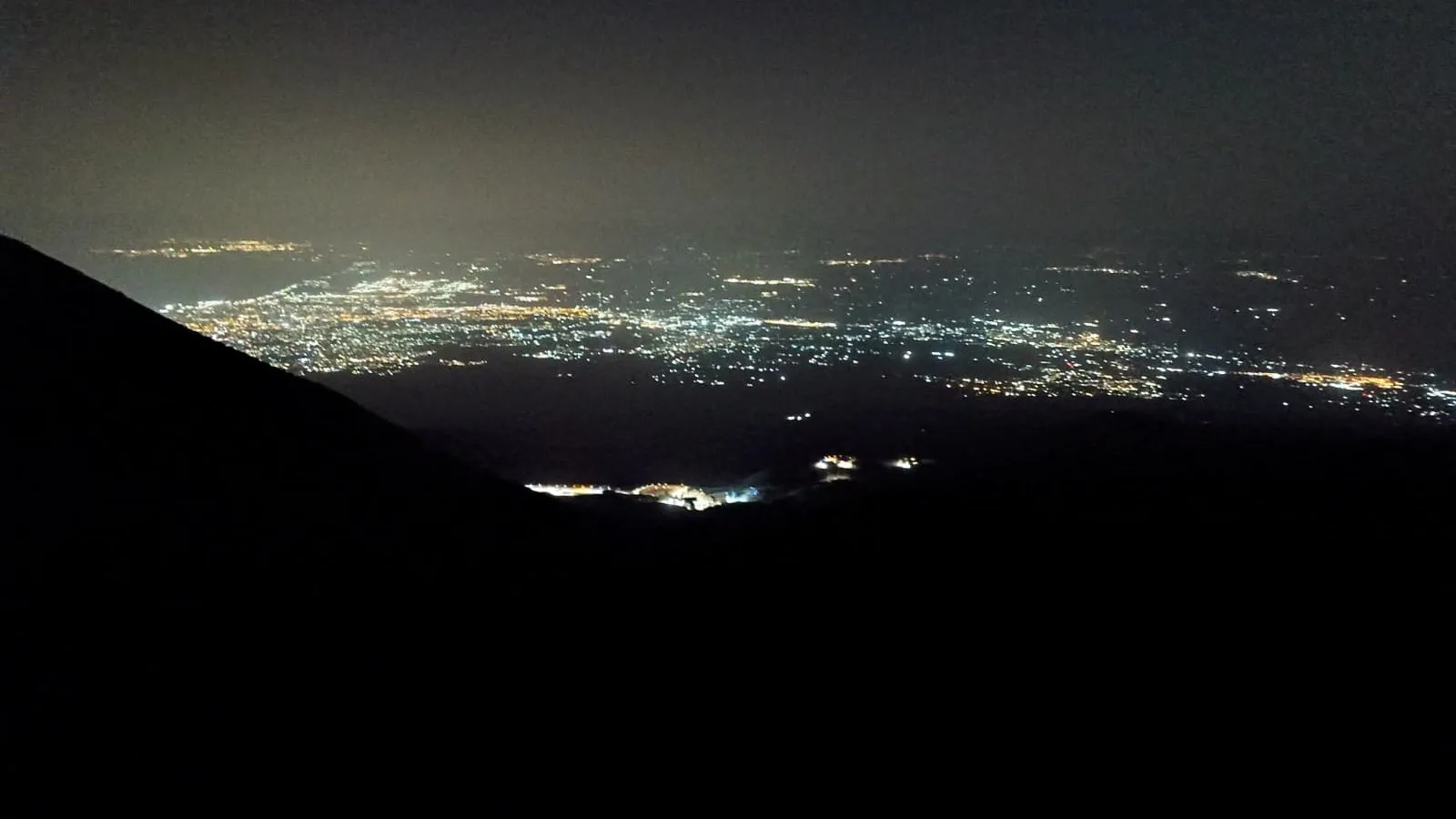
In the evening, from up high, the lights of the coast look small and far away. It's a lovely moment, but remember that to get back down there's still the whole mountain road to drive, in the dark.
At the Piazzale: parking and facilities
Parking
There are parking areas at the Piazzale, near the cable car and Rifugio Sapienza. The parking rules can change: they're signposted on site, so when you park, have a look at the signs.
On the busiest days, in August and on fine-weather weekends, there are more people at the Piazzale and finding a space can take a few extra minutes: one more reason to arrive early. As in any tourist car park, don't leave bags, documents or valuables on show.
If you're coming in a minibus or a camper van, tell me when you book, so we can take it into account.
Cable car, refuge and places to eat
On the Piazzale you'll find the departure station of the Funivia dell'Etna, with Rifugio Sapienza right next to it. Around it there are also places to get a hot drink or something to eat. For the summit craters, lunch isn't included: sort it out beforehand, so you don't waste time.
Remember that at the Piazzale you're already at about 1,900 m. Even in summer, when you get out of the car the air is cooler than in Catania and it's often windy: keep a sweatshirt or a jacket within reach.
If you arrive very early, the Crateri Silvestri are close by and you can see them well even from the side of the road. Stay near the Piazzale, though, so you're ready at the agreed time.
Without a car: bus, taxi and transfers
The AST bus from Catania
If you don't have a car, there's a scheduled bus run by AST, the Azienda Siciliana Trasporti (Sicilian Transport Company), which links Catania with Etna as far as Rifugio Sapienza, in other words the Piazzale. It leaves from Piazza Giovanni XXIII, the square outside Catania's central station, which is also the terminus for other intercity bus routes. The journey takes about two hours: it's a long road, and uphill all the way.
Tickets and timetable
There are only a few services: usually one bus up in the morning and one back in the afternoon. The timetable can change with the season and on some public holidays there's no service, so don't rely on something you read months ago: always check it on the AST website, which you'll find among the sources at the bottom of the page, in the days before you travel.
You can also buy the return ticket on board. Be aware, though: buying it in advance doesn't guarantee you a seat. In the busiest periods, get to the stop a little early.
If you're coming by bus
If you're coming by bus, tell me when you book. With only a few services a day, the excursion has to be organised so that you reach the Piazzale on the bus and are back at the stop in time for the return journey.
The quad, which takes 1.5–2 hours, is usually easier to fit into the day. For trekking and the craters the duration depends on the day's route: in that case we'll talk about it beforehand, and I'll tell you honestly whether you can do everything by bus without rushing. If you miss the bus back you'll have to make other arrangements, a taxi for example: always bear that in mind.
Taxis and transfers
Another option is a taxi or a private transfer from Catania, the airport or your hotel. It's the most convenient solution if you don't drive, if you're coming from Taormina or Syracuse, or if the bus times don't fit around the excursion.
Book it in advance and arrange the return journey straight away too: you won't necessarily find a taxi available at the Piazzale when you need one. And give the driver the right name, ‘Etna Sud, Rifugio Sapienza, piazzale della funivia’, or the coordinates.
If there are a lot of you, a family or a group of friends for example, a private tour, organised just for you, may also make sense. Write to me with where you're starting from and I'll tell you the simplest way to arrive on time.
When to arrive and where we meet
How early to arrive
We agree the time when you book, because it changes with the season and the excursion. My advice is to arrive a little before the agreed time: that gives you time to park, put on the gear and get your instructions calmly, without rushing.
To work out what time to leave, do this:
- Take the time your satnav gives you from your hotel to the Piazzale.
- Add some extra time for traffic, bends and any fog, more in summer, at weekends and in winter.
- Add the time you need to park and get ready.
If the total seems long, that's how it should be: in the mountains, extra time is never wasted time.
Where we meet
On the agreed day we meet at Piazzale Funivia dell'Etna, at Etna South. The Piazzale is big, so I'll confirm the exact spot where we meet when you book. When you arrive, send me a message on WhatsApp: we'll find each other in no time.
If you're running late
It happens: traffic leaving Catania, a slow bus on the climb, fog. If you can see you're not going to make it, message or call me as soon as you realise, not once you've already arrived: that way I can tell you what to do. And don't speed round the bends to make up a few minutes. Better late than never.
What to wear when you arrive
So you don't waste time at the Piazzale, arrive already dressed for the excursion:
- Quad: long trousers and closed-toe shoes. We provide the helmet, hygiene cap, windproof jacket and gloves.
- Trekking and craters: long trousers and layers. We provide the helmet, shoes, socks, poles and a small backpack; for the craters, lunch isn't included.
- For everyone: water, and an extra warm layer in the car, even in summer.
The full list, season by season, is in the guide on what to bring on Etna.
My advice
If I had to sum it all up in a few lines:
- By car: enter ‘Funivia dell'Etna’ or the coordinates 37.6996, 14.9993, go up from Nicolosi on the SP92 and allow about an hour from Catania, plus some extra time.
- In winter: check the mountain forecast, take snow chains if snow is forecast and write to me the day before.
- Without a car: the AST bus from Piazza Giovanni XXIII works if the timetable fits around the excursion; otherwise a taxi or transfer, booked in advance.
- Always: arrive a little early and write to me when you get to the Piazzale.
Remember that trekking and the craters, up high, aren't suitable for anyone with heart or breathing problems: if you're unsure, let's talk first. Everything about who can go up and when excursions set off is in the guide on safety on Etna. To choose between the excursions, take a look at the quad in the woods, the trek up to 3,000 m and the climb to the summit craters.
Write to me with where you're starting from, the day you have in mind, how many of you there are and everyone's ages: I'll tell you the simplest way to get here and send you a quote. You'll find me on the contact page. Below is the map of the meeting point, with links to open it in OpenStreetMap, Apple Maps and Google Maps.
- Summit craters 3,400 m
- Trekking 3,000 m
- Piazzale Funivia dell'Etna, Etna South 1,900 m · Meeting point
- Nicolosi 700 m
- Catania
Frequently asked questions
Where is Piazzale Funivia dell'Etna?
On the south side of Etna, in the municipality of Nicolosi (CT), at about 1,900 m, next to Rifugio Sapienza. You'll also see it called Etna Sud (Etna South) or Nicolosi Nord. It's the meeting point for all the excursions.
How long does it take to drive from Catania?
About an hour from the city centre, depending on the traffic and where you're starting from. The last stretch, from Nicolosi upwards, is a mountain road with lots of bends: always allow some extra time.
What should I put in my satnav?
‘Funivia dell'Etna’ or ‘Rifugio Sapienza, Nicolosi’, or the coordinates 37.6996, 14.9993. Don't just type ‘Etna’: the volcano is huge and you could end up somewhere else entirely.
Is there a bus from Catania to the Piazzale?
Yes, the AST bus leaves from Piazza Giovanni XXIII, the square outside Catania's central station, and the journey takes about two hours. There are only a few services and the timetable can change with the season: check it on the AST website and let me know when you book.
Can you park at the Piazzale?
Yes, there are parking areas at the Piazzale. The parking rules are signposted on site; on the busiest days, arrive a little early.
Can you drive up in winter?
You can reach the Piazzale in winter too, but there may be snow and ice on the road, especially early in the morning and in the evening. Check the mountain forecast, get your car ready and write to me before you set off.
How early should I arrive?
A little before the time we agree, so there's time to park, put on the gear and get your instructions. Allow some extra time for the drive as well.
Related excursions
Sources and further reading
- AST – Catania–Etna bus (Rifugio Sapienza): departure point, days and tickets (in Italian)
- Etna cable car (Funivia dell'Etna) – Contact and departure station (Piazzale Funivia Etna Sud, Nicolosi Nord)
- Wikipedia – Rifugio Sapienza (in Italian)
- Wikipedia – Crateri Silvestri: the SP92 runs between the two craters (in Italian)
- Wikipedia – Catania Centrale station: Piazza Giovanni XXIII and intercity buses (in Italian)


