
Guide
What to bring on Etna and what to wear
By Edy · Updated · 18 min read
For an excursion on Etna, dress in layers, wear long trousers and bring water, sunglasses and sun cream: it's colder up high than down below and the weather changes quickly. The rest depends on the excursion: for the quad, we provide the helmet, hygiene cap, windproof jacket and gloves; for trekking and the craters, the helmet, hiking shoes, socks, poles and a small backpack.

‘Is it cold up there?’ and ‘Is the gear included?’ are among the questions I'm asked most often at the cable car station. The short answer is: dress in layers and don't underestimate the altitude. The long answer is in this guide: what we provide for each excursion, what's left to you, how to dress, what to put in your backpack and what to leave in the car. At the end you'll find a checklist to go through the evening before.
What we provide and what you bring
Before you pack your bag, it helps to know what you'll find ready for you. The gear changes from one excursion to another, because they're three different experiences: the quad is ridden in the woods on the south side, while trekking and the summit craters are done on foot, up high. All three start from Piazzale Funivia, Etna South, at about 1,900 m.
Quad in the woods
For the quad, we provide the helmet, hygiene cap, windproof jacket and gloves, and fuel is included. That leaves two things to you: long trousers and closed-toe shoes.
The quad takes 1.5–2 hours and doesn't head up towards the summit: you stay among the trees on the south side, where it's usually more pleasant than higher up. Under the windproof jacket a top is enough and, on cool days, a sweatshirt or a fleece. You don't need any other equipment: before setting off you'll get all the instructions you need to ride it with confidence. You'll find the details on the quad in the woods page.
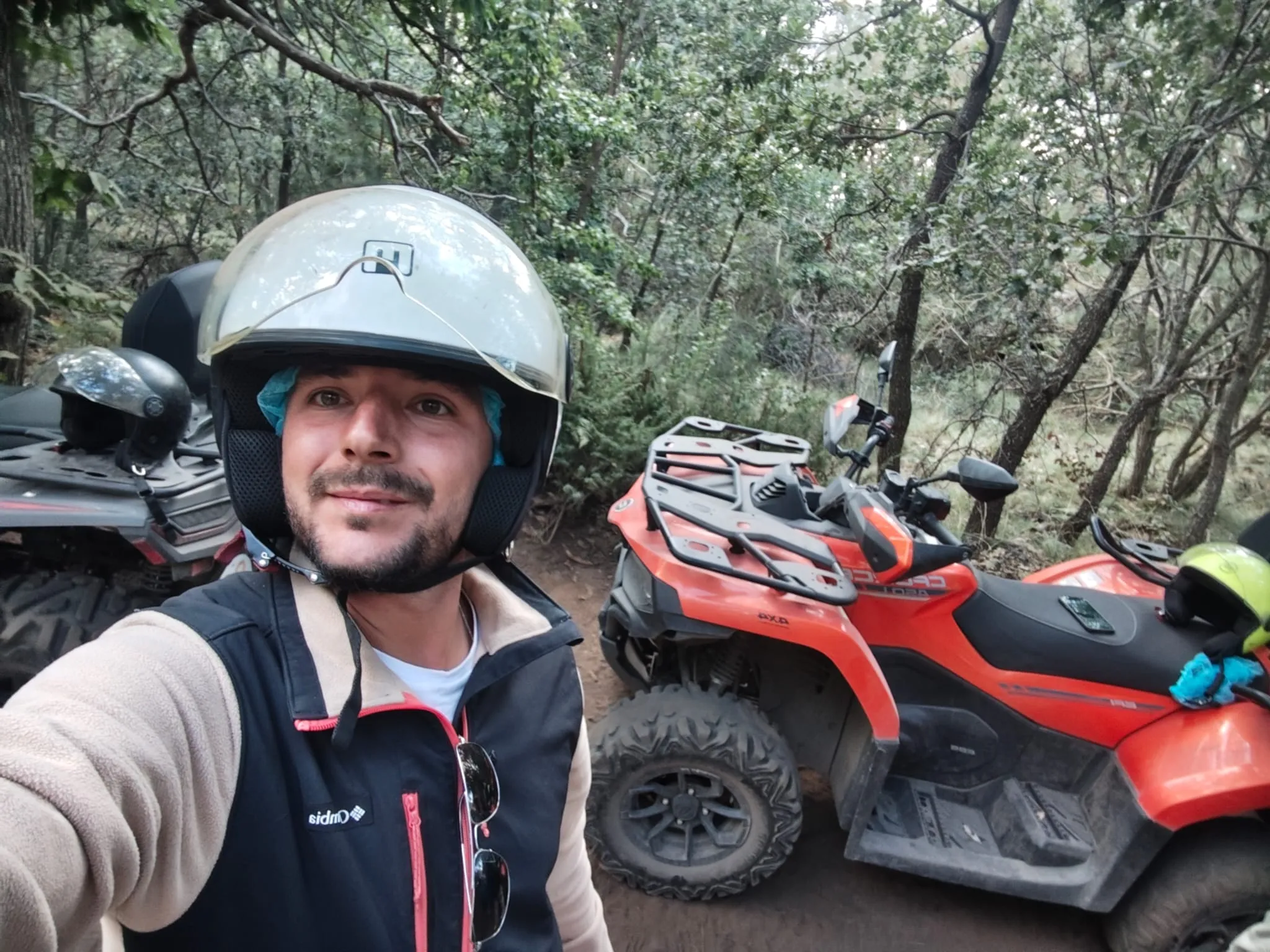
Here I am in the woods in my helmet: you can see the hygiene cap underneath. For the quad, we provide the helmet, hygiene cap, windproof jacket and gloves; you bring long trousers and closed-toe shoes.
Trekking at 3,000 m
For trekking, we provide the helmet, hiking shoes, socks, poles and a small backpack. The cable car ticket is extra. What's up to you is layered clothing, and here it's the most important part: you walk on ash trails up to 3,000 m, and how far you get is decided on the day, depending on the conditions. Your clothes need to work even if the weather changes during the day.
Trekking runs all year round, for ages 8 and up. It isn't suitable for anyone with heart or breathing problems. You'll find everything else on the trek up to 3,000 m page.
Summit craters at 3,400 m
The gear is the same as for trekking: helmet, hiking shoes, socks, poles and a small backpack. The cable car ticket and lunch are extra, and you bring the long trousers.
It's the highest excursion: it usually runs from June to August, in groups of 10–12 people, and only if the weather and volcanic activity allow it that day. Even in high summer, at 3,400 m you need a warm layer and a jacket that stops the wind. As with trekking, it isn't suitable for anyone with heart or breathing problems. Here's what the climb to the summit craters is like.
How to dress: layers
The advice I give everyone, in any season, is to dress in layers. Not because it's always cold on Etna, but because the temperature changes with altitude, with the wind and with the time of day. With several thin layers you take off and add whatever you need; with one heavy jumper you're either too hot or too cold.
Why it matters up high
On average, as you climb, the temperature drops by about 6.5 °C for every 1,000 m. It's an average figure that varies with the day, but it gives you an idea. From the cable car station, at about 1,900 m, up to 3,000 m it's about 7 degrees less; up to the craters at 3,400 m, around ten. If it's 30 degrees in the city, you may find around ten up high, and with the wind it feels colder still.
Then there's the way you walk: on the way up you warm up, and when you stop in the wind the cold reaches you within minutes. Layers let you keep up with your body and with the weather, which in the mountains can change from one moment to the next. If you'd like to know what the weather is like in each season, I've explained it in the guide on when to visit Etna.
The first layer: a light top
Next to your skin, wear a light top, ideally a technical one, the kind that dries quickly. You sweat on the way up, even when the air is cool, and a top that stays wet makes you feel cold as soon as you stop in the wind. In summer a T-shirt is enough; in winter, a long-sleeved top.
The warm layer
Over the top goes a layer that keeps you warm: a sweatshirt, a fleece or a light jumper. In summer a thin fleece may be enough; in winter you need a heavier one. It's the layer you take off and put back on most often, so choose one that rolls up easily and fits in the small backpack without any trouble.
The jacket
The outer layer is the one that protects you from the wind and, if possible, from the rain too. For the quad the windproof jacket is included; for trekking and the craters, bring your own. In summer a light windproof jacket is enough; in spring, autumn and winter you need a proper jacket that's also waterproof. You don't need an expedition jacket: you need one that stops the wind.
Long trousers, always
For the quad and the craters, long trousers are essential, and for trekking I recommend them anyway. They protect your legs from dust, sun and wind, and on ash trails they're much more comfortable. Hiking trousers are fine, or any comfortable pair that lets you move your legs freely when you climb, go down or sit on the quad.
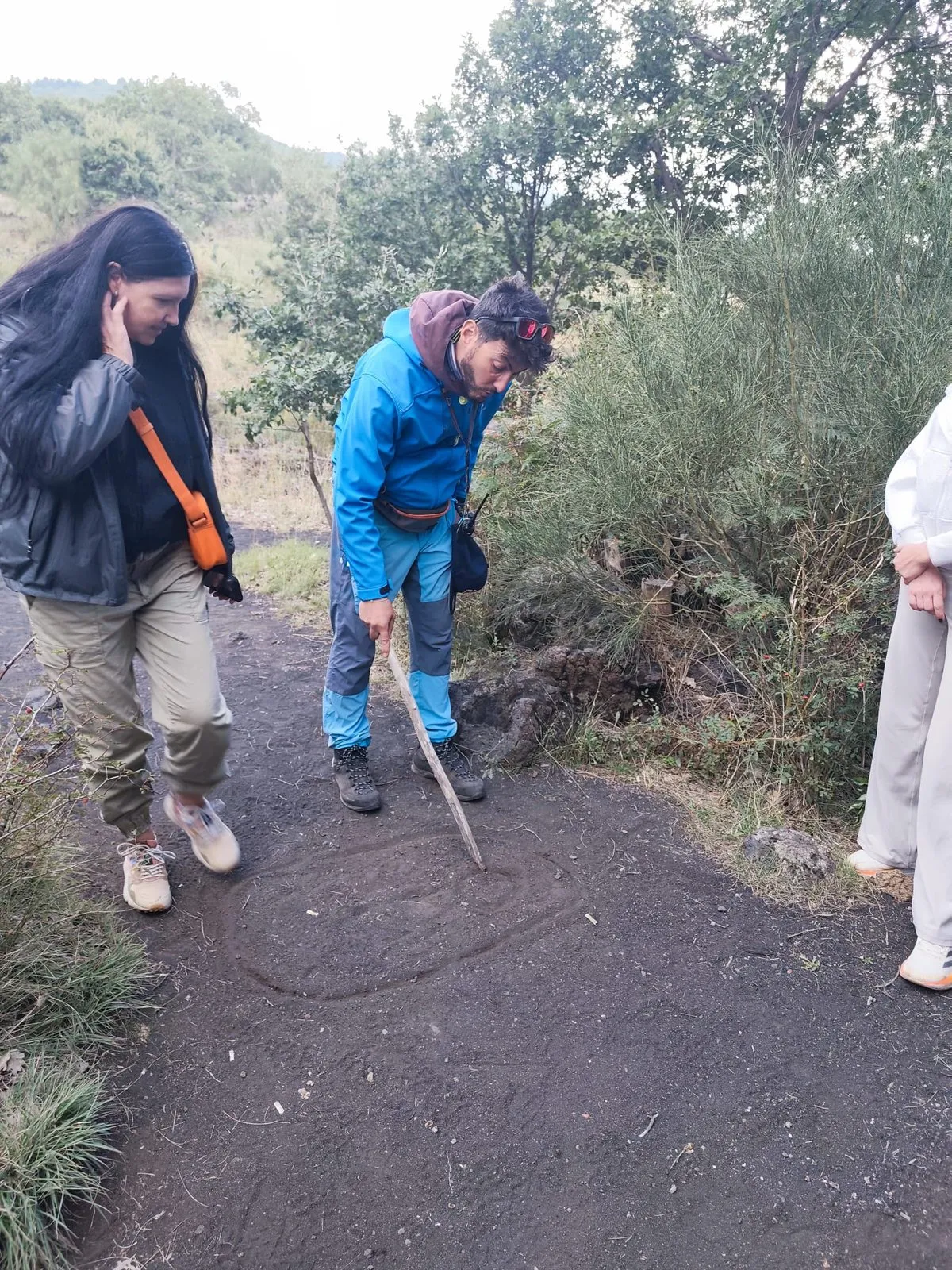
An overcast day, on a path among the shrubs: a jacket over a sweatshirt, long trousers and closed-toe shoes, with the small things in a shoulder bag or a bum bag. That's the idea of layers, put into practice.
Shoes
People have lots of questions about shoes, but the answer is simple, and it's different for the quad and for the excursions on foot.
For the quad: closed-toe shoes
For the quad you need closed-toe shoes: trainers or any comfortable shoes that cover your feet well. On the quad your feet need to be protected, and the ground in the woods is earth and volcanic dust. No sandals, flip-flops, sliders or open shoes, not even in summer.
For trekking and the craters: we provide them
For trekking and the summit craters, hiking shoes and socks are included. You don't need to buy any specially for the trip, or pack heavy boots in your suitcase. Come in comfortable closed-toe shoes anyway: they're the ones you arrive at the cable car station in and leave in. If you already have your own hiking shoes and would rather use them, write to me beforehand and we'll talk about it.
Volcanic ash is fine and dusty, and at the end of the day it's normal to find it pretty much everywhere. Spare socks and clean shoes for the way back, left in the car, are a small luxury. The same goes for the quad, after an hour and a half of dust and dirt tracks.
Sun, wind and cold
Up high, three things surprise people going up for the first time: the sun that burns even when the air is cool, the wind, and the cold that sets in as soon as you stop. For each of them, a few things are enough, packed in your backpack before you set off.
The sun up high
The higher you go, the thinner the atmosphere above you, and the less it filters ultraviolet rays. According to Italy's National Institute of Health (Istituto Superiore di Sanità), UV levels rise by 10–12% for every 1,000 m of altitude, and snow reflects about 80% of the radiation. In other words: at 3,000 m the sun is stronger than at the seaside, and in winter, with snow, it also reaches you from below.
The problem is that up high you don't notice it: the air is cool, there may be wind, and the sun doesn't seem to warm you. Even a few thin clouds aren't enough to protect you. So always bring:
- High-factor sun cream, to put on before you set off and reapply roughly every two hours.
- Sunglasses, which also help against the wind and dust.
- A hat, especially in summer.
- Lip balm with sun protection: with sun and wind, your lips dry out quickly.
The wind
Above the tree line there's no shelter, and up high the wind can be strong and cold even when the sun is out. What meteorologists call wind chill kicks in: the wind carries away the layer of warm air that forms on your skin, and the stronger it is, the colder you feel, even if the thermometer hasn't changed.
That's why the windproof jacket is the most important item of clothing you have. A sweatshirt on its own isn't enough in the wind. And with strong winds, the day's plans can change: whether you go up, and how far, is decided by the conditions on the day, on the spot.
Head, hands and neck
For your head, hands and neck, three small things are enough: they weigh next to nothing and fit in a pocket.
- A beanie, in spring, autumn and winter.
- A pair of gloves for trekking when it's cool. For the quad, gloves are included.
- A neck warmer or a light scarf, useful against the wind and dust.
If you have long hair, bring a hair tie too: in the wind, and under a helmet, it's much more comfortable tied back.
Eyes and dust
On the quad, volcanic dust is part of the experience, and on the ash trails the wind easily stirs it up. Sunglasses help here too. If you wear contact lenses, put a pair of glasses in your bag as well, in case the dust bothers you.
Backpack, water and food
For an excursion on Etna you don't need a big backpack: you need a few things, the right ones, in the right place.
The trekking backpack
For trekking and the craters, we provide the small backpack. Plan what you bring around that size: the warm layer, the jacket, water, a snack and the small things for the sun. Everything else can wait for you in the car. On the way up, a light backpack on your shoulders makes all the difference.
On the quad: just the essentials
For the quad, bring only the essentials: phone, keys and wallet, in zipped pockets or a bum bag. The less you have on you, the more you'll enjoy the ride. If you think you'll need to bring a backpack, tell me beforehand and we'll work out together how to manage.
Water
Always bring water, in every season. For trekking and the craters, allow at least one bottle per person, and an extra one in summer: better too much than too little. Drink in small sips on the way up, without waiting until you're thirsty. In winter, a flask of something hot during a break is a real treat.
Snacks and lunch
For trekking, bring a snack that gives you energy without weighing you down: nuts, an energy bar, a piece of fruit, a bit of chocolate or a small sandwich. For the quad, which takes 1.5–2 hours, something to eat before or after is usually enough.
For the summit craters, lunch is extra, like the cable car ticket. You can bring it from home, something simple and easy to eat even in the wind, or ask me when you book how to sort it out. Either way, don't set off on an empty stomach: it's the highest of the three excursions.
What to keep within reach
Some things you'll reach for often, and they shouldn't end up at the bottom of your backpack:
- Sunglasses, sun cream and lip balm, in an outside pocket or your jacket pocket.
- Your phone, charged, for photos and so we can stay in touch.
- Paper tissues and a bag for your rubbish.
- The warm layer and the jacket at the top of the backpack, because they're what you'll take out most often.
- The water bottle where you can reach it without taking your backpack off, if you can.
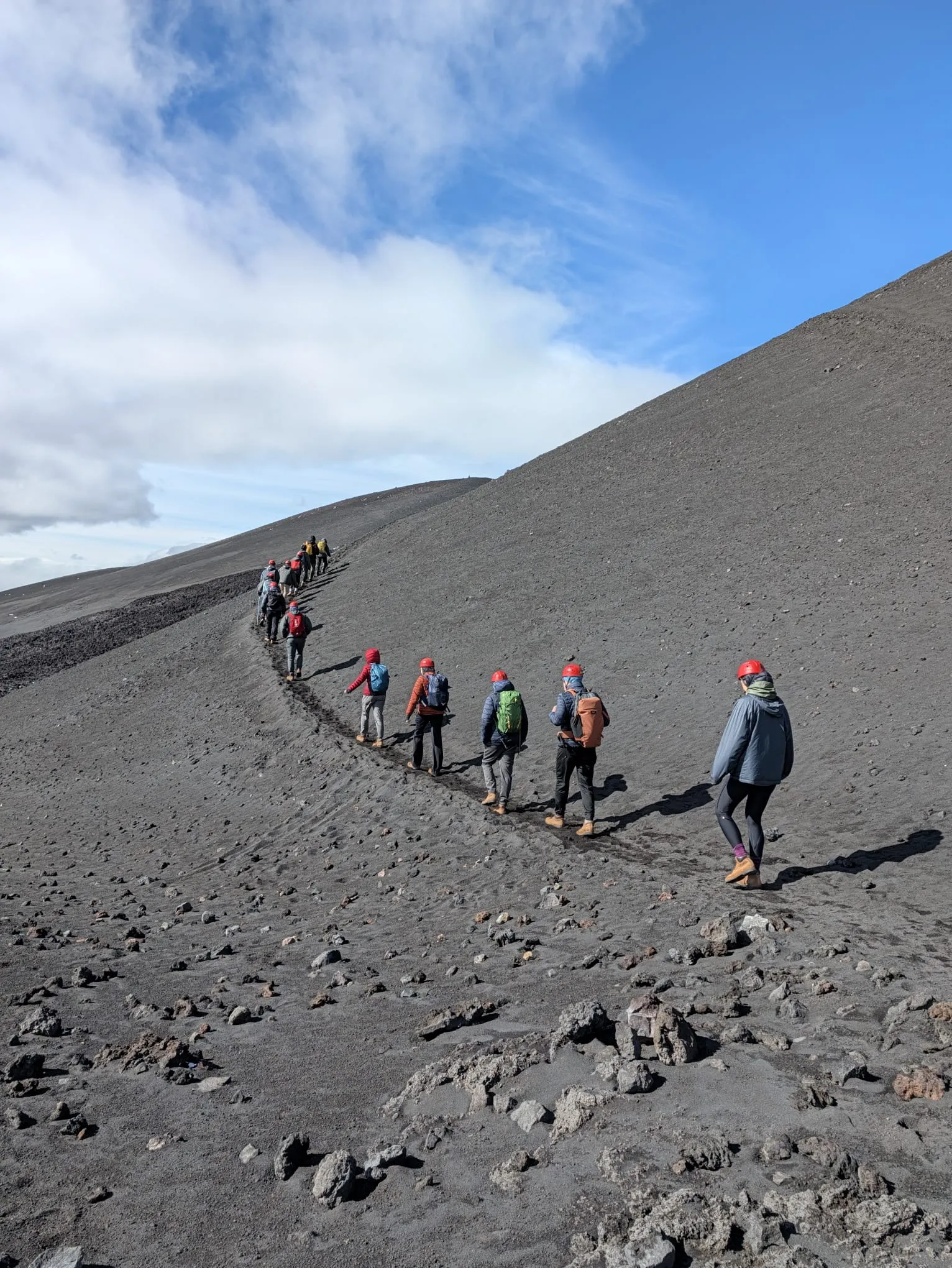
On the ash trail, in single file: helmets on, small backpacks on their shoulders, jackets and long trousers. The sun is out, and yet almost everyone is wearing an extra layer.
If you're coming with children
With children, everything I've written applies, with a little extra care. The quad is suitable from age 6 and trekking from age 8, as long as they're physically up to it and it's safe.
- An extra warm layer, even in summer, because it's colder up high than in the city.
- Long trousers and closed-toe shoes for them too.
- Sun cream, sunglasses and a hat.
- Water, a few snacks and a complete change of clothes in the car.
If your child has heart or breathing problems, such as asthma, high-altitude excursions aren't suitable. You'll find more tips in the guide on Etna with kids.
What to bring, season by season
The gear we provide is the same all year round; what changes is your clothing. Here's what to add, season by season. To find out what to expect up high month by month, and which excursions run when, read the guide on when to visit Etna.
Summer (June–August)
This is the season when people get it wrong most often: it's hot down below and they arrive at the cable car station in shorts and a T-shirt, while up high the wind can be cold even in July.
- Sun cream, sunglasses, a hat and lip balm.
- Long trousers, a technical T-shirt and a light fleece.
- A light windproof jacket for trekking and the craters.
- More water than usual.
Spring and autumn
These are seasons of transition: lower down it can be mild, while up high the cold days linger or set in, sometimes with patchy snow. Compared with summer, add a warm layer, a jacket that keeps out the wind and rain, and a beanie and light gloves for trekking. Sun cream and sunglasses stay in the backpack.
Winter (December–February)
In winter it's seriously cold up high, and snow can come down as far as the area around the cable car station. The quad and trekking also run in this season, if conditions allow; the summit craters don't.
- A long-sleeved top, a heavy fleece and a warm, waterproof jacket.
- A beanie, gloves for trekking and a neck warmer.
- Spare warm socks in the car.
- Sunglasses and sun cream: snow reflects the sun.
With snow, the route and altitude are decided on the spot, on the day. Write to me beforehand: I'll tell you what else you need.
The quad at sunset
The quad can also be done at sunset, on request, when the season allows. The light among the trees changes, and after sunset the temperature drops quickly: bring an extra layer to wear under the windproof jacket, even if it was hot during the day.
What to leave at home or in the car
Knowing what not to bring is as useful as knowing what to bring. The less you carry that you don't need, the freer you are to enjoy the day.
What you don't need
- Sandals, flip-flops and open shoes: the quad needs closed-toe shoes, and for trekking we provide the shoes.
- Shorts and skirts for the excursion: keep them for the way back.
- An umbrella: with the wind up high it's not much use. A waterproof jacket is better.
- Big bags, suitcases and heavy backpacks: anything you don't need during the excursion just slows you down.
- Jewellery and valuables you don't need: with all the dust, ash and wind, you're only likely to damage or lose them.
What to leave in the car
There are parking areas at the cable car station, and your car becomes your storage space for the day. You can leave there:
- A change of dry clothes and a pair of shoes for the way back.
- Spare socks.
- Extra water and something to eat afterwards.
Don't leave bags or valuables in view on the seats: put them in the boot or take them with you. If you're coming by bus, on the other hand, you won't have the car as a base: bring only what you can wear or carry in the small backpack.
Respect the volcano
The volcano is protected by Etna Park, the first park to be established in Sicily. Bring back down everything you take up, even fruit peel and tissues: up there, litter stays where you leave it. Leave stones and plants where you find them; the best souvenirs to take home are your photos.
The checklist for each excursion
Here's everything in one table. Save it on your phone or go through it the evening before, item by item.
| Item | Quad | Trekking 3,000 m | Craters 3,400 m |
|---|---|---|---|
| Quad helmet, hygiene cap, gloves | We provide them | — | — |
| Windproof jacket | We provide it | You bring | You bring |
| Trekking helmet, poles, small backpack | — | We provide them | We provide them |
| Hiking shoes and socks | — | We provide them | We provide them |
| Closed-toe shoes | You bring | For getting there and back | For getting there and back |
| Long trousers | You bring | You bring | You bring |
| Top and warm layer | You bring | You bring | You bring |
| Beanie and gloves | Gloves included | You bring, if it's cool | You bring, if it's cool |
| Sunglasses and sun cream | You bring | You bring | You bring |
| Water | You bring | You bring | You bring |
| Snack | Optional | You bring | You bring |
| Lunch | — | — | Extra |
| Cable car ticket | — | Extra | Extra |
| Change of clothes for the way back | In the car | In the car | In the car |
‘We provide them’ means you'll find them ready for you at the cable car station. ‘Extra’ means it isn't included: ask me when you book how to sort it out, so there are no surprises.
The evening before and the morning of
- Check the forecast for up high, not for the city, and write to me if you're unsure.
- Get your layers, water, snack and sun gear ready; charge your phone.
- Put the change of clothes for the way back in the car.
- In the morning, put on sun cream before you set off and get dressed for the excursion straight away.
- Arrive at the cable car station a little before the agreed time: that gives you time to put on the gear and get the instructions without rushing.
If you're coming by car or bus, the guide on getting to Piazzale Funivia has directions and tips.
My advice
If I had to sum it all up in a few lines: we provide the technical gear, and it's up to you to dress well. Layers, long trousers, closed-toe shoes, a jacket that stops the wind, water and sun protection: with these, you're ready for all three excursions.
- Quad: long trousers and closed-toe shoes; helmet, hygiene cap, windproof jacket and gloves are included.
- Trekking at 3,000 m: layers, a jacket, water and a snack; cable car extra.
- Summit craters: as for trekking, plus lunch, and a warm layer even in high summer.
High-altitude excursions aren't suitable for anyone with heart or breathing problems: in that case, let's talk first and look at the quad together. Everything about who can go up and when excursions set off is in the guide on safety on Etna. If you haven't decided which excursion to do yet, the guide on quad or trekking will help you choose.
Write to me the day before, if you like: I'll tell you what the forecast says for up high and what's worth packing in your backpack. For dates, availability and a quote, you'll find me on the contact page.
Frequently asked questions
How should I dress for an excursion on Etna?
In layers: a light top, a warm layer and a jacket that keeps the wind out, plus long trousers. It's colder up high than down below, even in summer, and with layers you can take off or add whatever you need.
What's included with the quad, and what do I need to bring?
We provide the helmet, hygiene cap, windproof jacket and gloves, and fuel is included. You bring long trousers and closed-toe shoes.
Do I need to buy hiking boots to go up to 3,000 m?
No. For trekking and the summit craters, hiking shoes and socks are included, along with a helmet, poles and a small backpack. Come in comfortable closed-toe shoes for the journey anyway.
Is lunch included?
For the summit craters, lunch is extra, like the cable car ticket: bring your own, or ask me how to sort it out when you book. For trekking, bring at least water and a snack.
Do I need sun cream even if it's cool?
Yes. As you climb, UV rays increase by about 10–12% for every 1,000 m, and snow reflects them. Sun cream, sunglasses and a hat are needed even when the air is cool.
Can I wear shorts in summer?
Not for the excursion: for the quad and the craters you need long trousers anyway, and up high it can be cold even in July. Leave your shorts in the car for the way back.
What should I bring if I come in winter?
Properly warm clothing, a beanie, gloves for trekking and a waterproof jacket. With snow, the route and altitude are decided on the day: write to me beforehand and I'll tell you what else you need.
Related excursions
Sources and further reading
- Italian National Institute of Health (Istituto Superiore di Sanità, EpiCentro) – Ultraviolet radiation (in Italian)
- WHO – Questions and answers on ultraviolet (UV) radiation
- Meteo.it – Glossary: vertical temperature gradient (in Italian)
- Meteo.it – Glossary: wind chill (in Italian)
- Etna Park Authority (Ente Parco dell'Etna)


