
Guide
Quad or trekking on Etna: which to choose
By Edy · Updated · 17 min read
Choose the quad if you have about two hours, you're travelling with children aged 6 and up or you don't want to walk uphill; choose trekking at 3,000 m if you enjoy walking and want the Etna of the ash trails. The summit craters at 3,400 m are for anyone coming in summer who wants to reach the highest point, if conditions allow it that day.

‘Quad or trekking: which is better?’ is one of the questions I'm asked most often at Piazzale Funivia. There's no single best excursion: there's the right one for you, for the time you have, for the people you're travelling with and for the season you're coming in. In this guide I'll explain what each of the three excursions is really like, who it's for and who it isn't for, and what I'd recommend, so you arrive at the cable car station knowing what you want.
The three excursions at a glance
All three start from Piazzale Funivia, Etna South, at an altitude of about 1,900 m, above Nicolosi and near Rifugio Sapienza. From there on, though, they're three very different experiences: one stays among the trees, while two climb on foot towards the upper part of the volcano.
Quad in the woods
It's the excursion people choose most often at the cable car station. You ride the quad yourself along the dirt tracks through the woods on the south side, for 1.5–2 hours, without heading up towards the summit. It runs all year round, for ages 6 and up, and on request at sunset too, when the season allows.
No experience needed: before setting off you'll get all the instructions you need to ride it with confidence. The helmet, hygiene cap, windproof jacket, gloves and fuel are included; you bring long trousers and closed-toe shoes. All the details are on the quad in the woods page.
Trekking up to 3,000 m
It's the excursion for anyone who wants to feel Etna under their feet: you climb on foot, along ash trails, up to 3,000 m. It runs all year round, for ages 8 and up, in groups of up to 20–30 people. How far you get is decided on the day, depending on the conditions, and the duration also depends on the day's route.
We provide the helmet, hiking shoes, socks, poles and a small backpack. The ticket for the cable car, which climbs from Piazzale Funivia to about 2,500 m, is extra. You'll find everything on the trek to 3,000 m page.
Summit craters at 3,400 m
It's the highest excursion: the highest point you can reach, at the edge of the summit craters. It usually runs from June to August, with some exceptions, for ages 8 and up and in small groups of 10–12 people. It's also the one that depends most on the conditions: the weather and volcanic activity determine whether you go up and how far.
The gear is the same as for trekking; the cable car ticket and lunch are extra, and you bring your own long trousers. Here are the details of the climb to the summit craters.
The comparison in a table
If you want to see everything together, here are the three excursions side by side. This is general guidance: for trekking and the craters, whether you go up and how far is decided by the conditions on the day.
| Feature | Quad | Trekking 3,000 m | Summit craters 3,400 m |
|---|---|---|---|
| Where you go | Woods on the south side | Ash trails up to 3,000 m | Up to the edge of the summit craters, 3,400 m |
| How you get around | You ride the quad yourself | On foot, uphill | On foot, uphill |
| Effort | Low: no walking, but the dirt track calls for attention | Walking at altitude: depends on your fitness | Walking up to the highest point: depends on your fitness |
| Duration | 1.5–2 hours | Depends on the day's route | Depends on the day's route |
| Season | All year round; at sunset on request | All year round | Usually June–August |
| How much it depends on conditions | Less: it stays among the trees | A lot: how far you get is decided on the day | Most of all: sometimes you can't go up |
| Age | From age 6 | From age 8 | From age 8 |
| Group | Depends on the request | Up to 20–30 people | Small groups, 10–12 people |
| Included | Helmet, hygiene cap, windproof jacket, gloves, fuel | Helmet, hiking shoes, socks, poles, small backpack | Helmet, hiking shoes, socks, poles, small backpack |
| Extra and what to bring | Bring long trousers and closed-toe shoes | Cable car extra; bring layered clothing | Cable car and lunch extra; bring long trousers |
| Not suitable for | Children under 6 | Anyone with heart or breathing problems; children under 8 | Anyone with heart or breathing problems; children under 8 |
| Who it's for | Anyone short on time, families, anyone who doesn't want to walk uphill | Anyone who loves walking and wants to see Etna up high | Anyone coming in summer who wants to reach the top |
Two rows deserve an explanation. The duration of trekking and the craters isn't given in hours because it changes with the route taken that day: ask me when you book. And ‘all year round’ means the excursion has no closed season, not that it goes ahead in any weather.
What each one is really like
On paper the differences are clear. What matters, though, is how it feels while you're doing it: the landscape, the pace, the effort. I'll tell you what I see every day, without promising things that don't depend on me.
The quad: engine, dust and trees
The quad is all about movement. You feel the roar of the engine, the volcanic dust kicking up from the dirt track, the branches overhead and the woods on the south side opening up in front of you. People come as couples, families or groups of friends, and the atmosphere is that of an adventure to share.
There's no uphill walking, so the physical effort is low. What you do need is attention: it's an activity on dirt tracks, and before setting off you get all the instructions and gear you need to ride with confidence. You don't need to have ridden one before.
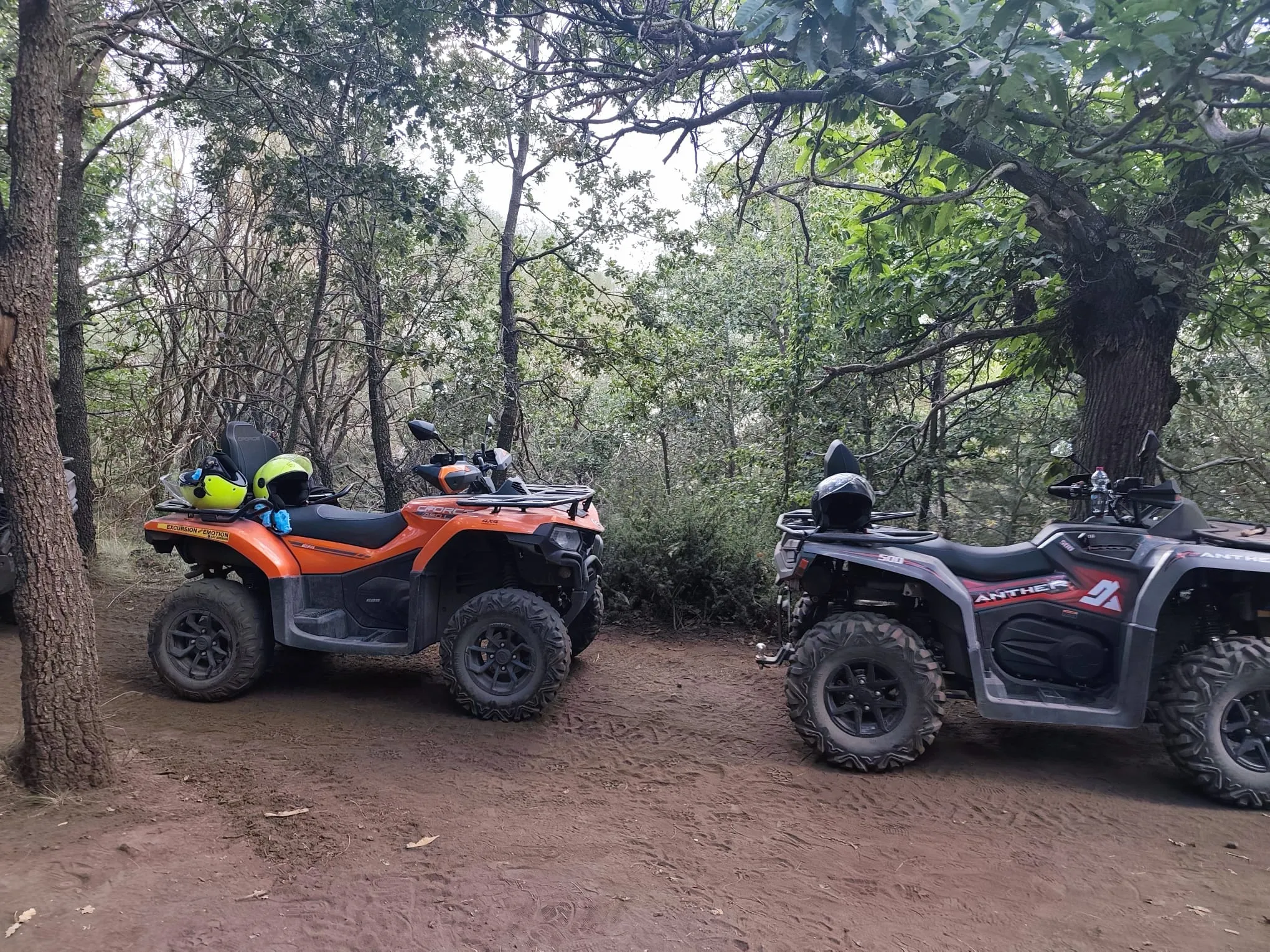
This is the quad's world: earth, trees and dirt tracks. Nothing like the black ash higher up.
The quad stays among the trees, well away from the altitudes of the trek and the craters, and that has two consequences. First: you won't see the craters up close, because the quad doesn't head towards the summit. Second: it's the excursion least affected by what happens up high. When there's cloud up high, it matters less to the experience among the trees; with heavy rain, snow on the route or wind, on the other hand, whether to set off is assessed on the day. And in summer, the woods are more pleasant than the city.
Trekking: step by step on the ash
Trekking is something else: it's slow, quiet, made of footsteps. You walk uphill on trails of ash and lava stones, above the tree line, where there's no shelter and the landscape turns black and grey. If the sky is clear you can see a long way, but the view depends on the day: on Etna clouds form and move quickly, and sometimes you find yourself inside one.
There is effort involved, and it's only fair to say so. You climb on foot and at altitude, where less oxygen is available and your body works harder to compensate. How hard it feels depends on your fitness and the conditions on the day: with wind, cold or snow in winter, the same climb becomes more demanding. If you're not used to walking, tell me beforehand: I'll tell you honestly whether it's right for you.
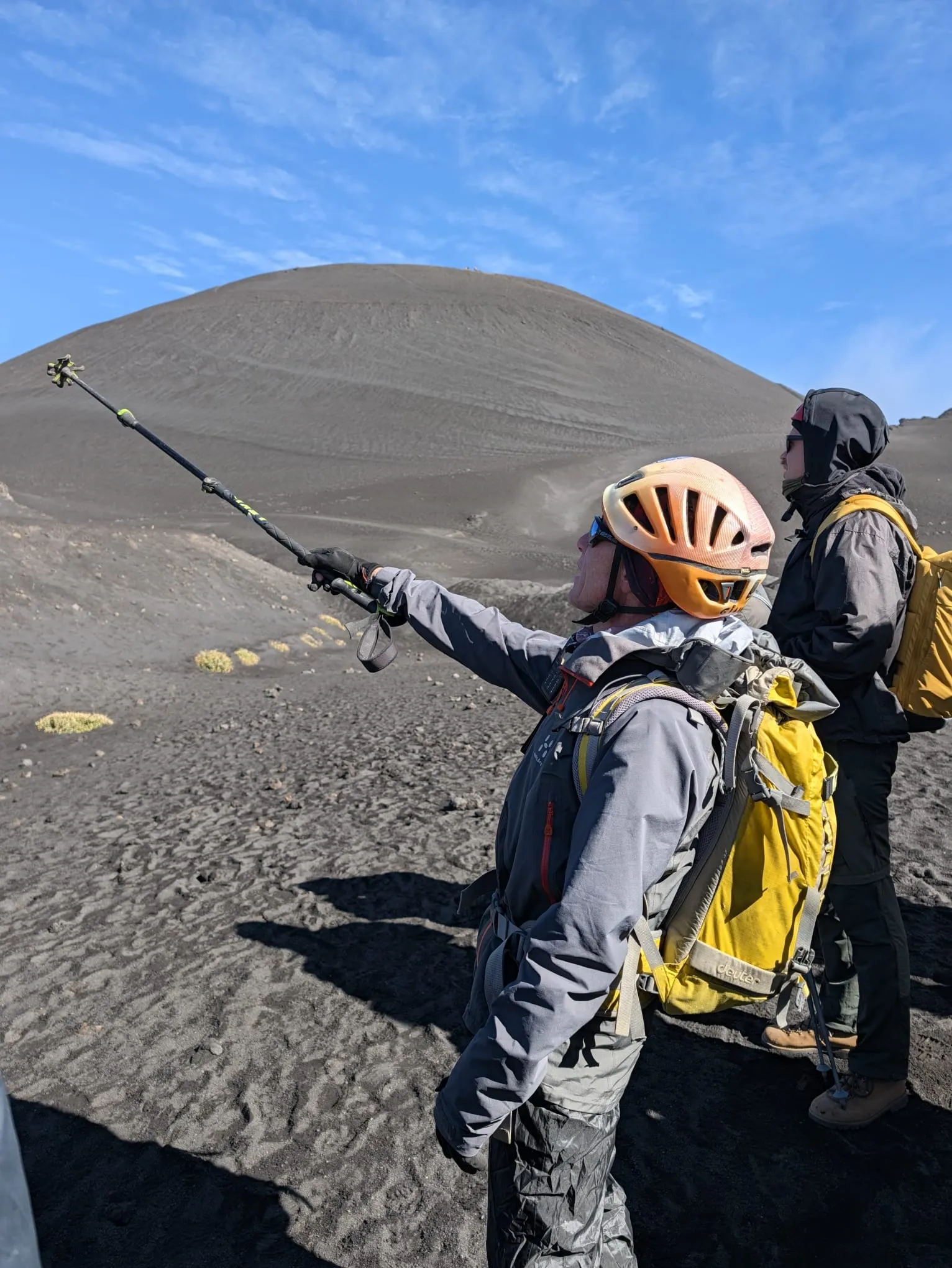
Up high the landscape changes completely: no trees, just ash, stones and the odd tuft of low plants. And look at how they're dressed: jacket and hood, even under a clear sky.
It's colder up high than at the cable car station. On average the temperature drops by about 6.5 °C for every 1,000 m: from the station's 1,900 m or so up to 3,000 m, that's about 7 degrees less, and with the wind it feels colder still. That's why, even in summer, you need layered clothing.
A question I'm often asked: can you go up on your own? Yes, but only up to a certain altitude. Higher up, you can only go accompanied.
The craters: the highest excursion
The summit craters are the excursion for anyone who wants to reach the top, at the edge of the craters of Europe's highest active volcano. It's the one that makes you feel most strongly that Etna is alive: a plume of gas and steam often rises from the craters, and all around there's nothing but ash and volcanic rock.
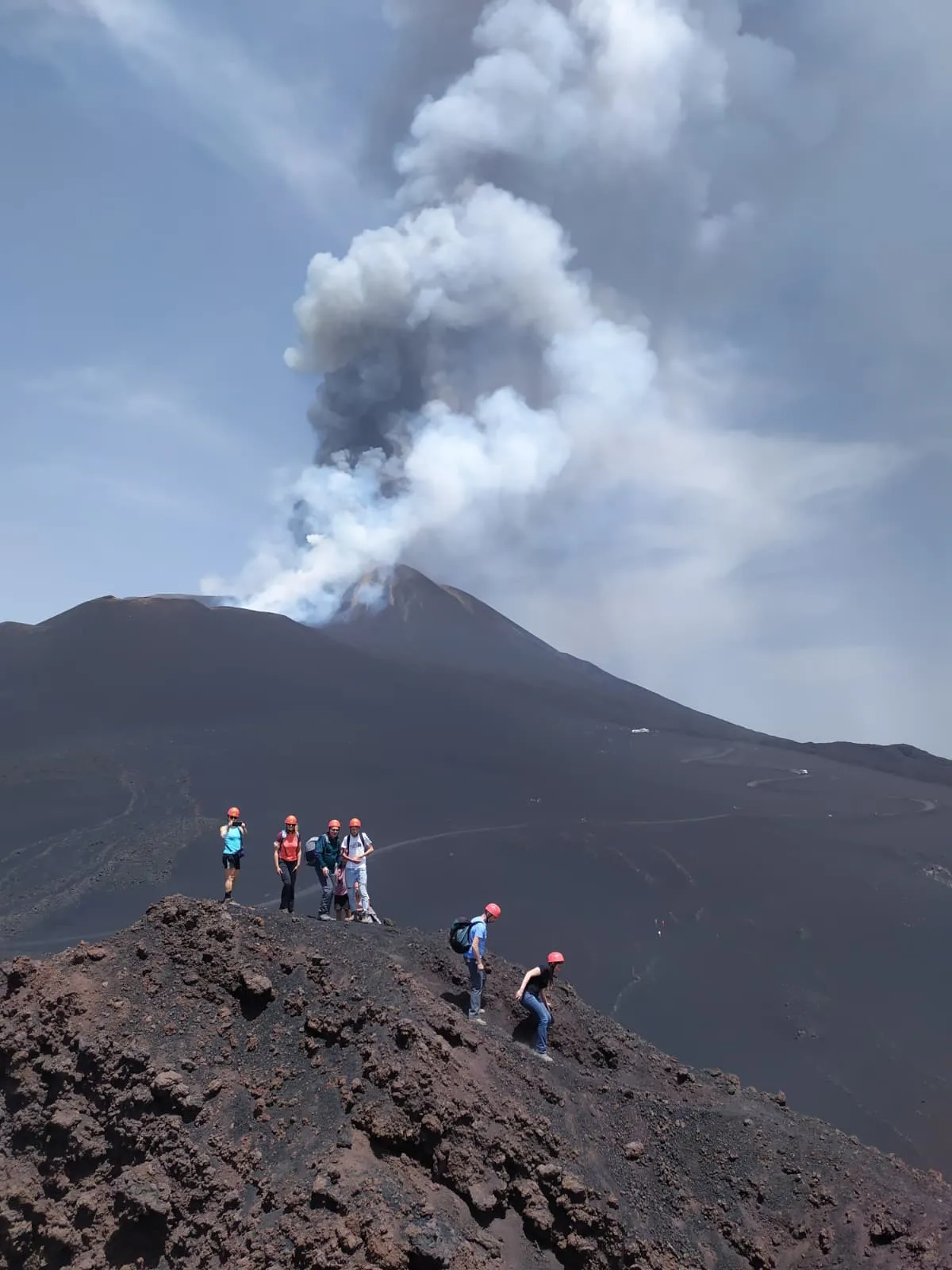
In front of the summit craters, the landscape is made of ash, rock and gas. How active the volcano is changes from day to day, and that's why the craters depend on the conditions more than the other excursions do.
Compared with the trek, you climb higher, to about 3,400 m: there's even less oxygen available and you feel the cold more, at around ten degrees less than at the cable car station. The summit changes too: with eruptions the craters grow or collapse, and the high-altitude routes aren't always the same.
It's also the excursion with the narrowest window: usually from June to August, and even in those months there are days when you can't go up. You rarely see lava, and only when safety conditions allow it: I can't promise it, and be wary of anyone who guarantees it. Groups are small, and in summer the places run out sooner. Lunch isn't included: ask me what's best to bring.
Who it's for and who it isn't
Each excursion has its own kind of visitor. Here's how I see it, after many days spent helping the people who arrive at the station to choose.
The quad is for you if…
- You're short on time: you'll be done in 1.5–2 hours.
- You're travelling with children aged 6 and up.
- You want to have fun without walking uphill.
- You like the idea of riding, even if you've never done it before.
- You're coming at a time when the high ground is uncertain, because of snow or wind.
It's not for you if your goal is to see the craters up close, or if you're looking for mountain silence: the quad has an engine, and you can hear it.
Trekking is for you if…
- You enjoy walking and want to see Etna up close, on foot.
- You want to go up high at any time of year.
- You're travelling with young people aged 8 and up who like walking.
- You're in good health and have no heart or breathing problems.
It's not for you if you really don't like walking uphill, or if you have a fixed commitment straight afterwards and can't afford for the day's plans to change.
The craters are for you if…
- You're coming between June and August.
- You want to reach the highest point you can get to.
- You enjoy walking and you're in good health.
- You have a few days' flexibility, because it's the excursion that depends most on the conditions.
Who shouldn't go up high
There are no half measures here. Trekking and the craters aren't suitable for anyone with heart or breathing problems, such as asthma: we don't let them go up high, for their own safety.
The reason is simple. The higher you go, the less oxygen is available in the air, and to compensate your body makes your heart and lungs work harder. If you're also walking uphill, your need for oxygen grows even more. For a healthy person that means effort; for someone who already has a heart or lung problem, it can become a risk.
If you have doubts about your health, write to me before booking and, if necessary, ask your doctor. For anyone who can't go up high, the alternative we can look at together is the quad in the woods, which doesn't head towards the summit. Everything about who can go up is in the guide on safety on Etna.
Age: children and over-65s
The quad is suitable from age 6, trekking and the craters from age 8, as long as they're physically up to it and it's safe. If you're over 65, we talk it through first, based on your physical condition: it's not an automatic no, it's an assessment we make together. If you're travelling with little ones, the guide on Etna with kids has more tips.
How to choose: five questions
When someone at the cable car station asks me which excursion to do, I answer with questions. Here they are, so you can ask yourself before you write to me.
How much time do you have?
If you only have a couple of hours, the choice is the quad: it takes 1.5–2 hours. For trekking and the craters the duration depends on the day's route: ask me when you book, and don't plan anything else straight afterwards.
The time of day matters too. The air up high is often clearer in the morning, while during the day clouds can climb the slopes. If you only have the afternoon free, the quad is often the simplest choice.
How fit are you?
Be honest with yourself. If you never walk and the idea of a climb worries you, the quad is the most relaxed choice. If you enjoy walking, trekking is the natural choice. If you enjoy walking, you're in good health and you're coming in summer, you can think about the craters. Either way, tell me your age and how active you are: I'll tell you if it's right for you.
Who's travelling with you?
A group moves at the pace of whoever finds it hardest. With children under 8, the quad is the only one of the three excursions that's suitable. With parents or friends who aren't very fit, or with someone over 65, let's talk first. If you'd rather keep it to just your own group, there's also the option of a private tour, with the quad, trekking or the craters.
What season are you coming in?
The quad and trekking run all year round; the craters usually from June to August. In winter, with snow, the trek adapts and how far you go is decided on the spot; the quad remains the simplest excursion, but rain, snow and ice on the route matter there too. You'll find everything, season by season and month by month, in the guide on when to visit Etna.
What will the weather be like?
It's the question nobody can answer days in advance. In the mountains the weather changes from one moment to the next and the forecast is the only source: check it for the altitude, not for the city, and close to the day. The weather matters more for the excursions up high: wind, cloud and cold change a day of trekking or at the craters far more than a quad ride. If you write to me the day before, I'll tell you what the forecast says for up high and we'll decide together.
Combining excursions over several days
You don't have to pick just one. If you have a few days on Etna, two different excursions show you two faces of the volcano: the woods and the high ground.
Combinations that make sense
- Quad and trekking: the woods one day, the ash and altitude another. It's the easiest pair to organise, because both run all year round.
- Quad and craters: in summer, for anyone who wants to see both the woods and the highest point.
- Trekking and craters: makes sense if you love walking at altitude. More often, trekking is one of the alternatives to consider when, on the day of the craters, the conditions don't allow you to go all the way up.
Two excursions on the same day? Ask me first: it depends on the timings and the conditions. If you can, split them over two days and you'll enjoy them more.
What order to do them in
Put the excursion that depends most on the conditions first, which means the high-altitude one. If you can't go up on the day you've chosen, you still have time to try again, while the quad, which is less affected by what happens up high, is easier to fit into the other days.
And always keep a free day after the high-altitude excursion, especially for the craters. Don't put it on the last day of your holiday: if you can't go up that day, you'd have no way of trying again.
If conditions don't allow it
It happens, and it's part of the volcano. On the day of the excursion, the weather or volcanic activity may not allow what you'd chosen. Here's what can happen, so you're not caught unprepared.
Lower, later or not at all
For trekking and the craters, how far you go is decided on the spot, on the day. Sometimes it's enough to change the time, sometimes you don't go as high, sometimes it's better to change day. If the conditions aren't right, the excursion doesn't go ahead. Ask me how a change of date works when you book: I'll tell you straight away, so there are no surprises.
Etna's activity is monitored day and night by INGV's Etna Observatory, which publishes updates and bulletins. This is valuable information, but it describes what's happening now, not what will happen next week: that's why the choice is always made on the day.
The alternatives
- If the craters are off: sometimes trekking, which stops lower down, is still possible. It's assessed on the day.
- If you can't go up high: the quad in the woods, which doesn't head towards the summit, is the alternative we can look at together.
- If even the quad isn't possible: with heavy rain, snow on the route or wind, we look for another day.
What I'll never advise you to do is go up high when the conditions aren't right, even if you've travelled a long way to get here. Better to put it off by a day than to go up on the wrong day.
My advice
If I had to sum it all up in a few lines, I'd put it like this:
- If you're short on time or travelling with children aged 6 and up, choose the quad: 1.5–2 hours in the woods, all year round, with no uphill walking.
- If you enjoy walking, you're in good health and you want the Etna of ash and silence, do the trek to 3,000 m, in any season.
- If you're coming between June and August and want to reach the highest point, go for the summit craters at 3,400 m: keep a spare day and write to me early, because the groups are small.
- If someone in your group has heart or breathing problems, no high altitude for them: let's look at the quad together.
- If you have two or three days, combine them: the high-altitude excursion first, then the quad.
Before you go, also read what to pack in the guide on what to bring on Etna, and how to reach the meeting point in the guide on getting to Piazzale Funivia.
Still not sure? Write to me with how many of you there are, everyone's ages, how much time you have and when you're coming: I'll advise you myself, based on what you need and what you can manage, and send you a quote. I speak Italian, English and a little French. You'll find me on the contact page.
Frequently asked questions
Which is better on Etna, the quad or trekking?
It depends on your time, age and fitness. The quad takes 1.5–2 hours, is open to ages 6 and up and involves no uphill walking; on the trek you climb on foot up to 3,000 m, from age 8. Tell me who's coming and how much time you have, and I'll tell you which one suits you.
Can you reach the craters by quad?
No. The quad is ridden in the woods on the south side, without heading up towards the summit. To reach 3,000 and 3,400 m you go up on foot.
Is the trek to 3,000 m hard work?
You walk uphill and at altitude, so there's some effort involved. How much depends on your fitness and the conditions on the day: tell me your age and how active you are, and I'll tell you if it's right for you.
Who can't do the trek or the craters?
Anyone with heart or breathing problems, such as asthma: we don't let them go up high, for their own safety. For them, the alternative we can look at together is the quad in the woods.
Which excursion should I choose with children?
The quad is suitable from age 6 and is the easiest one to enjoy as a family. Trekking and the craters are from age 8, as long as they're physically up to it and it's safe.
Can I do the quad and the trek on different days?
Yes, and it's a good way to see both the woods and the high ground. Put the high-altitude excursion first, as it depends more on the conditions, and keep a spare day.
What happens if you can't go up on the day I've chosen?
If the conditions aren't right, the excursion doesn't go ahead, or you don't go as high: it's decided on the spot, on the day. In that case we look together at another date or another excursion, such as the quad.
Related excursions
Sources and further reading
- Etna cable car (Funivia dell'Etna): the cable car climbs from 1,920 m to 2,500 m
- INGV – Etna Observatory (Osservatorio Etneo): monitoring, updates and bulletins on Etna
- Etna Park Authority (Ente Parco dell'Etna)
- Centro Cardiologico Monzino – Heart and mountains (Cuore e montagna, 2016): oxygen, the heart and breathing at altitude (in Italian)
- Meteo.it – Glossary: vertical temperature gradient (in Italian)


