
Guide
Etna with children: how old do they need to be?
By Edy · Updated · 18 min read
Yes, you can visit Etna with children: the quad in the woods is suitable from age 6, and trekking at 3,000 m and the summit craters from age 8, as long as they're physically up to it and it's safe. For the youngest, the simplest choice is the quad; up high, whether you go up and how far is down to the conditions on the day.

‘Can I bring the kids too?’ It's one of the questions I'm asked most often at the cable car station. The answer is yes: you can visit Etna with children, as long as you choose the right excursion for their age and personality, and come prepared. In this guide I'll explain from what age each excursion is possible, which one to choose, how to get them ready for the cold and the altitude, and what to do if something isn't right halfway through the day.
The minimum age for each excursion
Every excursion has a minimum age. It's the first filter, not the only one: your child's physical condition matters too, and so do the conditions on the day. Here are the three excursions that start from Piazzale Funivia, Etna South, from the easiest to the most demanding.
Quad in the woods: from age 6
This is the excursion with the lowest minimum age: you can do it from age 6 upwards. You ride the quad through the woods on the south side, without heading up towards the summit, and it lasts 1.5–2 hours. It runs all year round and, on request, at sunset too, when the season allows.
No experience needed: before setting off you'll get all the instructions you need to ride it with confidence. If you're unsure what riding a quad with a child involves, ask me when you write: I'll explain everything beforehand, so you already know how it works when you get to the cable car station. You'll find all the details on the quad in the woods page.
Trekking at 3,000 m: from age 8
The trek is done on foot, on ash trails, up to 3,000 m. It's open to children and teenagers aged 8 and over, and runs all year round. How tiring it is depends on fitness and the conditions on the day, and how far you go is decided on the day itself.
Groups can be as big as 20–30 people. If you'd rather walk at your family's own pace, there's also the option of a private tour. Here's what the trek up to 3,000 m is like.
Summit craters at 3,400 m: from age 8
For the summit craters too, the minimum age is 8. But it's the highest excursion and the one that depends most on the conditions: it usually runs from June to August, with some exceptions, in small groups of 10–12 people, and only if the weather and volcanic activity allow it. For an 8-year-old who has never walked in the mountains, I usually suggest starting with the trek. Everything you need to know is on the summit craters page.
The right age isn't everything
Being old enough doesn't necessarily mean the excursion is right for your child. The ages always apply as long as they're physically up to it and it's safe, and to work that out I look at three things:
- Health: trekking and the craters aren't suitable for anyone with heart or breathing problems, such as asthma. That goes for adults and for children alike.
- How used they are to walking: a child who often goes on mountain walks experiences altitude very differently from one who isn't used to it.
- The conditions on the day: the weather and volcanic activity decide whether you go up and how far. The choice is made on the spot, on the day.
If the grandparents are coming too: for anyone over 65, let's talk about it first, based on their physical condition.
If your child is under 6
Under 6, none of the three excursions is suitable. If you're travelling with a young child, write to me anyway: sometimes the solution is for the adults or older siblings to take turns doing the excursion while someone stays with the little one. We'll talk it over and find the easiest way to organise your day.
Which excursion to choose: age and personality
Age tells you what's possible; your child's personality tells you what they'll enjoy. A 9-year-old who loves engines and gets bored walking will be happier on the quad than on the trek, even if they're old enough for both. In this table I sum up how I think it through when a family asks me for advice.
| If your child… | Excursion to consider | Why |
|---|---|---|
| Is under 6 | None of the three, for now | The quad is from age 6, trekking and the craters from 8 |
| Is 6 or 7 | Quad in the woods | It's the only one of the three suitable for their age: 1.5–2 hours, with no uphill walking |
| Loves engines or tires quickly when walking | Quad in the woods | The roar of the engine and volcanic dust, without walking uphill |
| Is at least 8 and enjoys walking | Trekking at 3,000 m | Ash trails all year round; how far you go is decided on the day |
| Gets scared by loud noises | Trekking, if they're at least 8 | Up high you walk in silence, without the noise of the quad's engine |
| Is at least 8 and fit, and you're coming in summer | Summit craters at 3,400 m | Usually June–August, groups of 10–12 people; it's the highest and the most dependent on conditions |
| Has heart or breathing problems, including asthma | No high altitude: let's look at the quad | Trekking and the craters aren't suitable |
Two things to note about the table. It's general guidance: the final decision always depends on your child's health and the conditions on the day. And ‘is at least 8’ means they've reached the minimum age, not that it's enough: for trekking and the craters, being used to walking matters a lot too.
The child who loves engines
For lots of children the quad is an adventure in itself: the roar of the engine, the dirt tracks, the volcanic dust, the trees all around. It's an off-road activity and requires attention, but it lasts 1.5–2 hours and is easy on the legs. For children aged 6 and up, and for families who are short on time, it's almost always the simplest choice.
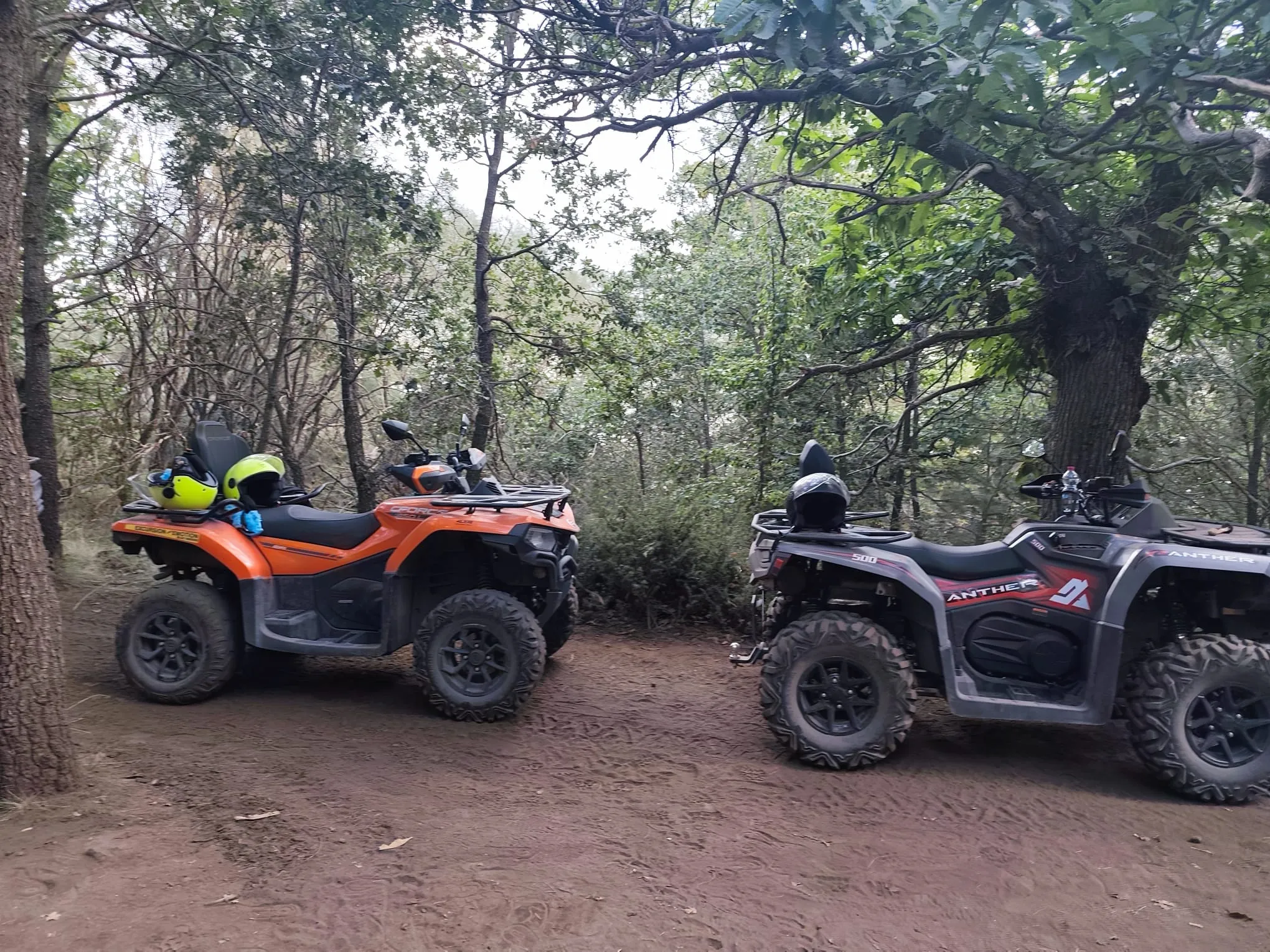
The quad is ridden among the trees on the south side, on dirt tracks like this one: no walking uphill, which is why it's the easiest excursion for the youngest.
The child who loves walking
If your child is at least 8, enjoys walks and has a thousand questions about everything, the trek at 3,000 m is the excursion to consider. You walk on ash, the landscape changes as you climb and you really feel Etna under your feet. It does call for some walking experience, though: it's not a stroll on the flat, and up high you feel the effort more.
The fit youngster who wants to go high
The summit craters are for young people aged 8 and up who walk without difficulty, and for those coming in summer. It's the highest excursion and the one that depends most on the weather and volcanic activity: even with everything organised, it may turn out that you can't go up that day. If your child dreams of the summit, prepare them for this possibility too.
Siblings of different ages
With siblings of different ages, the rule is simple: you choose based on the youngest. If one is 6 and the other 11, the quad works for both. If they're all at least 8 but one tires quickly, an excursion that suits everyone is better than a day with someone who can't keep up. When you write to me, tell me each child's age and habits: we'll find the solution together.
Getting them ready before you go
With children, much of the day is won or lost before you even reach the cable car station. A child who knows what to expect enjoys the excursion more, gets less scared and complains less about the cold, because they saw it coming.
What to explain beforehand
A few minutes at home or in the car are enough to go over the main points:
- Etna is an active volcano. A plume of gas and steam often rises from the craters, and that's normal. The volcano is monitored day and night by INGV's Etna Observatory, and if the conditions aren't right, nobody goes up.
- It's cold up high, even when it's T-shirt weather in town, and the wind can be strong.
- Helmets are there to protect them: they're worn as instructed, just like a seatbelt in the car.
- You listen to the instructions and stay close to the group, without running ahead.
- Ash is slippery and messy: you walk calmly, and clothes come home grey.
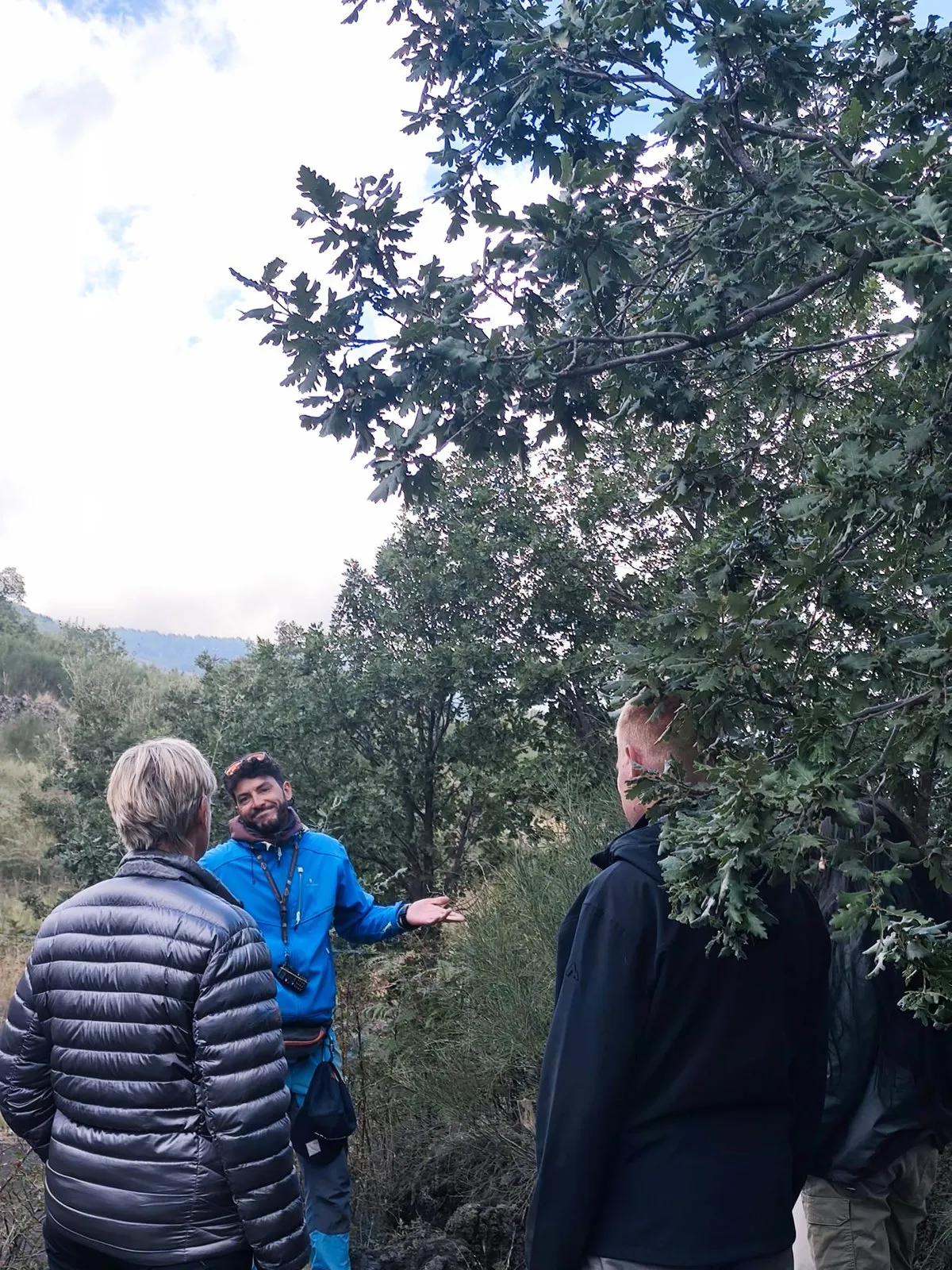
Explanations go down best when there's no rush, before setting off. With children this is even more true: telling them beforehand what they'll see makes the day easier for everyone.
No promises about lava
This is the most important thing. Lots of children picture Etna the way it looks in cartoons, with lava flowing everywhere. The reality is different: you rarely see lava, and only when safety conditions allow it. I can't promise it, and I'd advise you not to promise it either.
Instead, tell them what the excursion is actually like: for the quad, the woods, the dirt tracks and the volcanic dust; for the trek, the ash trails and the volcano's dark stones. Then, if the day brings something extra, it'll be a surprise rather than a broken promise.
Tell them a legend
Etna has stories that are perfect for children. According to Greek myth, the Etna region was home to the underground forge of Hephaestus, the god of fire and divine blacksmith, whom the Romans identified with Vulcan. Working alongside him were the Cyclopes, giants with a single eye in the middle of their forehead. Told in the car as you drive up to the cable car station, a story like this turns the smoke from the craters into something intriguing rather than frightening.
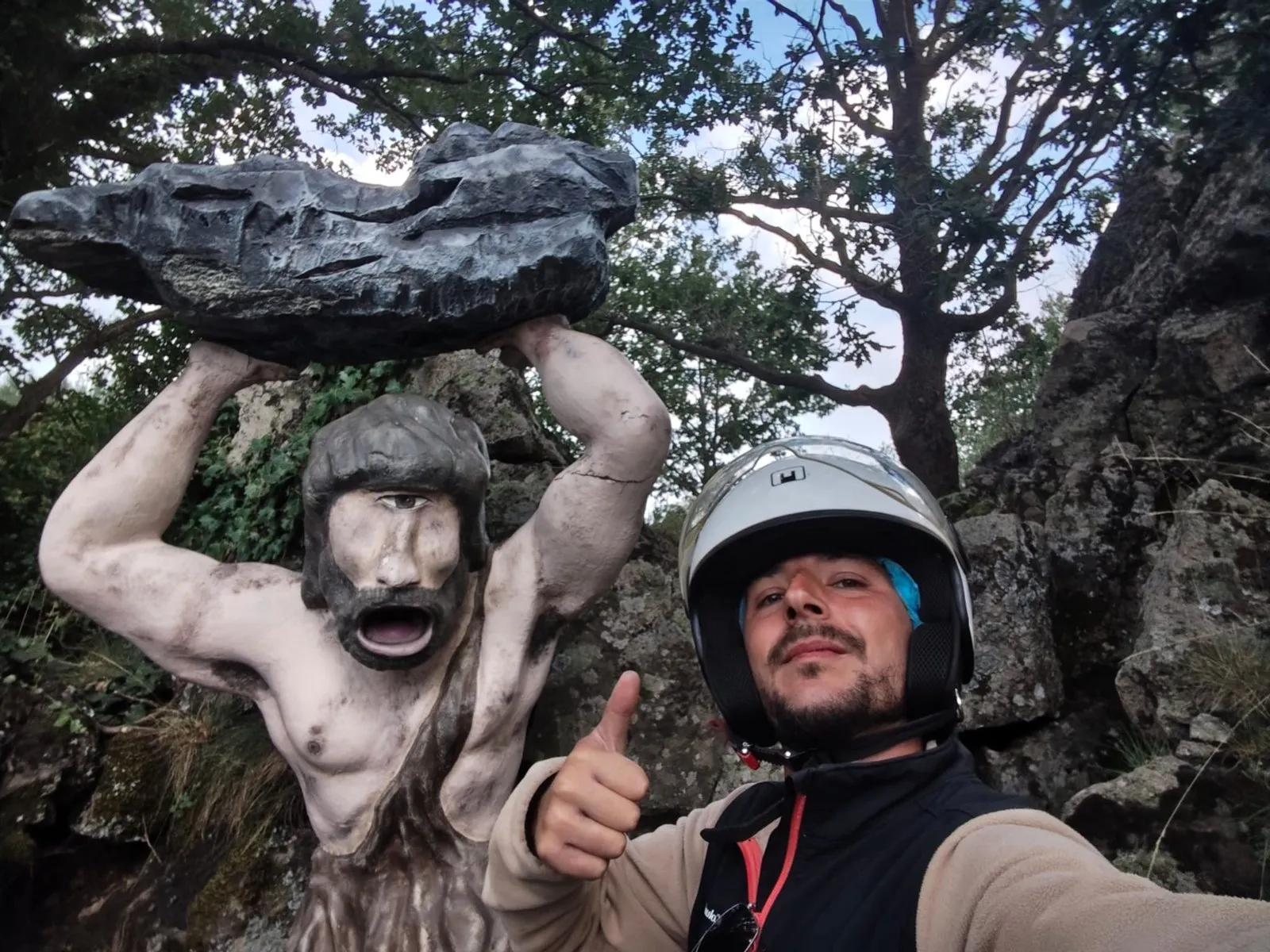
The statue of a Cyclops lifting a boulder, with a single eye in the middle of his forehead: just like in the myth. A picture like this helps children remember the story.
Get them involved
Children cooperate more when they feel part of the plan. Let them pack their own backpack, choose their warm layer and check the forecast with you the day before. If they understand why they need long trousers and a jacket, it'll be much easier to convince them to keep them on.
Altitude, cold and sun
This is the part that surprises families most. You leave Catania in the heat, and at the cable car station, at about 1,900 m, the air is already quite different. Higher up, the difference grows.
The higher you go, the colder it gets
On average, in the lower part of the atmosphere, the temperature drops by about 6.5 °C for every 1,000 m of altitude. It's an average figure that varies with the day, but it gives you an idea: from the cable car station to the 3,000 m of the trek it's about 7 degrees less, and to the craters at 3,400 m around ten. Compared with the coast, at 3,000 m the difference is about 20 degrees.
With the wind it feels colder still. And children have their own rhythm: they move about, they sweat, then they stop to look at something, and that's when they feel the cold. That's why layers matter more than a single heavy coat.
The sun up high
The sun is stronger up high, because the air is thinner and filters out less ultraviolet radiation. According to the World Health Organization, children and teenagers are particularly sensitive to UV rays, because of the way their skin and eyes are made. Sun cream, sunglasses and a hat are needed even when the air is cool and it doesn't feel as if you're getting burnt.
How to dress them
- Long trousers, always: for the quad and the craters they're a must, and you need them up high anyway.
- Closed-toe shoes for the quad; for trekking and the craters, we provide the shoes.
- Layers: a light top, a warm layer such as a fleece and a jacket that keeps out the wind.
- A beanie and gloves in the colder seasons, for trekking (for the quad, gloves are included).
- Clothes that can get dirty: volcanic dust and ash stick to everything.
What to bring and what we provide
Most of the gear is included. For the quad: helmet, hygiene cap, windproof jacket and gloves, and fuel is included too. For trekking and the craters: helmet, shoes, socks, poles and a small backpack; the cable car ticket is extra. If you have any doubts about sizes for the little ones, ask me when you book.
In the backpack, as well as clothes, pack water for everyone, something to eat during breaks, sun cream, sunglasses and a hat. For the summit craters lunch isn't included: ask me how best to organise yourselves. And leave a complete change of clothes for the children in the car, shoes included. You'll find everything in detail in the guide on what to bring on Etna.
Timing, pace and breaks
With children you need to plan your time carefully: the excursion itself, the journey there and a bit of margin for the unexpected.
How much time to allow
The quad lasts 1.5–2 hours, which is easy to manage even with the youngest. For trekking and the craters, on the other hand, the duration depends on the day's route: ask me when you book, and don't plan anything else straight afterwards.
Then add the journey: from Catania to Piazzale Funivia, allow about an hour, depending on traffic and where you're starting from, and the last stretch is a mountain road. If your child gets carsick, bear that in mind. Arrive a little early: there's gear to put on and instructions to listen to, and with children everything takes a few minutes longer. The route and tips are in the guide on getting to Piazzale Funivia.
The pace up high
On foot, up high, a steady pace matters more than speed with children. A few practical tips:
- Get them to drink often, even if they don't ask.
- Save the snack for the hard moments, not for the start.
- Give them small goals: that rock, that bend, that spot where you can see a long way.
- Praise them for every stretch they complete, not just at the end.
- If the group's pace is too fast for them, say so straight away.
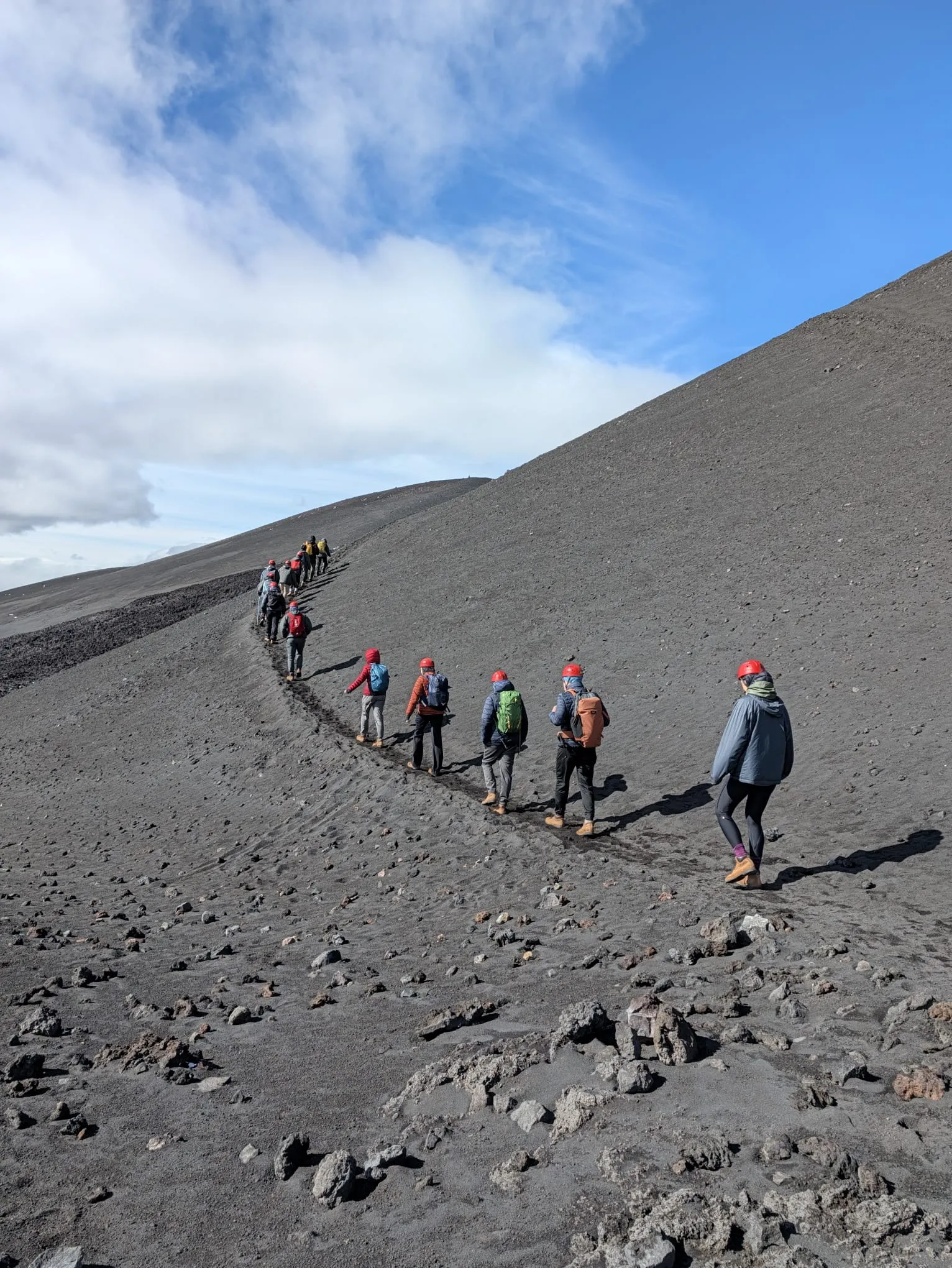
On the ash trail you climb in single file, one step after another. With children, keeping a steady pace matters more than getting there quickly.
Safety and health
With children, safety comes first, even before the day's plans.
Who can't go up high
Trekking and the craters aren't suitable for anyone with heart or breathing problems, such as asthma: we don't let them go up to high altitude, for their own safety. If your child has asthma or another health problem, tell me when you write and we'll look at the quad together. If you're unsure, ask your paediatrician before booking.
Rules for everyone
- The conditions on the day decide. Whether you go up and how far is decided by the weather and volcanic activity, on the spot, on the day. If the conditions aren't right, the excursion doesn't go ahead: with children, that's one more reason not to treat it as ‘now or never’.
- You don't go up high alone. Up to a certain altitude you can go on your own; higher up, you can only go accompanied. With children, don't improvise: an ash trail in fog and wind is not the place to explore by yourselves.
- The quad requires attention. It's an off-road activity: helmet on, and listen carefully to the instructions before setting off. Explain to the children that those instructions apply to them too.
Signs not to ignore
If your child is pale, has a headache, is unusually tired or very cold, don't wait for the end of the excursion: say so straight away. Better to stop for an extra moment than to grit your teeth. Everything about who can go up and when excursions set off is in the guide on safety on Etna.
When to go with children
The quad and trekking run all year round, the craters usually from June to August. With children, though, each season has its pros and cons.
In summer
It's the season when all three excursions are usually possible, and it often coincides with the school holidays. It's also the busiest: August is usually the fullest month, and for the craters, if you can, consider June or July. The sun up high is strong, and I recommend the morning for going up. The quad at sunset, on request, is a lovely idea with children too: bring an extra layer, because the temperature drops quickly after sunset.
In the other seasons
In spring and autumn, the quad and trekking are usually less crowded than in summer. Up high, though, it can already be cold, or still cold, with wind and sometimes patchy snow: a warm layer for the children is always needed.
In winter it's seriously cold up high and there may be snow. With children, the quad is the easiest excursion; trekking also runs in winter, but it's the season when conditions matter most. The craters aren't done in winter.
Whatever the season, don't put the excursion on the last day of your holiday. If the conditions aren't right that day, a free day afterwards lets you try again, instead of having to explain to the children that you're going home without doing it. For a month-by-month view, see the guide on when to visit Etna.
If your child is tired or scared
It happens, and it's normal. Even the most enthusiastic child can have a bad moment. The important thing is to notice early and not let it turn into a battle of wills.
If they're tired or cold
First of all, a break: water, something to eat, a few minutes sitting down. That's often enough. The cold is the main cause of grumpiness up high: an extra layer, a beanie and dry gloves change the day more than any pep talk.
If the tiredness doesn't pass, say so straight away, without waiting until you're struggling: up high it's not worth gritting your teeth, and what to do is decided together. On the quad you feel the effort less, but the same applies: if a child isn't feeling well, don't keep it to yourself.
If they're scared of the quad
The noise of the engine can be intimidating at first. Give them time to watch, to try on the helmet and to listen to the instructions with you. Don't force them: if they really don't feel up to it, it's better to know before setting off than halfway through.
If they're scared of the volcano
The smoke from the craters, the black ground, sometimes the fog: to a child, these can be unsettling. Reassure them with the real facts you told them beforehand: the volcano is monitored, and if the conditions don't allow it, nobody goes up. The legend of the Cyclopes helps here too: the smoke becomes the fire from their forge.
Giving up isn't failing
If a child doesn't feel up to it, stopping or giving up is the right choice. Etna isn't going anywhere, and a bad experience at 8 weighs more than a missed summit. Prepare them for this from the start: you go up if you can, and as far as you can.
My advice
If I had to sum it all up in a few lines:
- Children aged 6 and 7: the quad in the woods. It's the only one of the three excursions suitable for their age, it lasts 1.5–2 hours and it runs all year round.
- From age 8, if they love walking: trekking at 3,000 m, with layered clothing and a spare day.
- From age 8, fit, in summer: the summit craters at 3,400 m, preparing them for the idea that you only go up if conditions allow.
- With heart or breathing problems, including asthma: no high altitude; let's look at the quad together.
Write to me with how many of you there are, the children's ages, whether they're used to walking and the dates you have in mind: I'll tell you which excursion suits your family and send you a quote. You'll find me on the contact page.
Frequently asked questions
From what age can you visit Etna with children?
The quad in the woods is suitable from age 6; trekking at 3,000 m and the summit craters at 3,400 m from age 8. Always as long as they're physically up to it and it's safe.
Which excursion is best for young children?
The quad in the woods: it lasts 1.5–2 hours, runs all year round and doesn't involve walking uphill. For children aged 6 and 7, it's the only one of the three excursions they can do.
Can children go up to the summit craters?
Yes, from age 8, usually from June to August and only if the weather and volcanic activity allow it. It's the highest excursion: let's weigh it up together based on how fit your child is.
Can a child with asthma do the high-altitude trek?
No. Trekking and the craters aren't suitable for anyone with heart or breathing problems, such as asthma. In that case, let's talk first and look at the quad together.
How should I dress children for Etna?
In layers and long trousers, even in summer; for the quad they need closed-toe shoes. It's colder up high and the sun is strong: bring an extra warm layer, sun cream and sunglasses.
Will the children see lava?
I can't promise it. You rarely see lava, and only when safety conditions allow it: it's better not to get their hopes up, and to tell them what the excursion is really like.
Related excursions


