
Guide
Safety on Etna: who can go up and when excursions set off
By Edy · Updated · 18 min read
The quad in the woods is for ages 6 and up, trekking at 3,000 m and the craters at 3,400 m for ages 8 and up, as long as you're physically up to it. High-altitude excursions are not suitable for anyone with heart or breathing problems. Whether you go up, and how far, is decided on the spot by the conditions on the day: weather and volcanic activity.

Is the quad safe? Can it tip over? Is the trek difficult? Can I go up if I have asthma? These are the questions I hear most often before people make up their minds, and they're the right ones to ask. In this guide I'll answer them honestly: who can do each excursion, what the altitude feels like, why the weather and the volcano are assessed on the day itself, and what you can do, in practice, to enjoy the day with peace of mind. Not to scare you, but because on Etna you have a much better time when you know what to expect.
Who can do each excursion
Three very different excursions start from Piazzale Funivia on Etna South, at about 1,900 m. The altitude changes, the effort changes, and so does who can take part. Here's the overall picture; then we'll go into the details.
| Excursion | Where you go | Age | Season | Heart or breathing problems |
|---|---|---|---|---|
| Quad | Woods on the south side | From age 6 | All year round | Let's discuss it before you book |
| Trekking | On foot up to 3,000 m | From age 8 | All year round | Not suitable |
| Summit craters | On foot up to 3,400 m | From age 8 | Usually June–August | Not suitable |
The same goes for all three: age is a starting point, not an automatic green light. The physical condition of whoever is going up matters too, and so do the conditions on the day.
Quad in the woods
The quad is the easiest excursion to take on. It lasts 1.5–2 hours, runs all year round and stays in the woods on the south side: it doesn't head up towards the summit, because to reach 3,000 and 3,400 m you go on foot. It's open to ages 6 and up, as long as they're physically up to it and it's safe, and you don't need any riding experience: before setting off you'll get all the instructions you need. You'll find the practical details on the quad in the woods page.
Trekking at 3,000 m
The trek is on foot, along ash trails, up to 3,000 m. It runs all year round, for ages 8 and up, and the group can be as large as 20–30 people. It's an excursion that asks something of your legs and your lungs: how demanding it is depends on your fitness and on the conditions on the day, because with snow or wind the same climb becomes a different thing altogether. How far you get is decided on the day. Everything else is on the trekking at 3,000 m page.
Summit craters at 3,400 m
It's the highest excursion and the one that depends most on the conditions. It usually runs from June to August, with some exceptions, for ages 8 and up and in small groups of 10–12 people. You go up to the edge of the summit craters, so on top of the altitude you're also close to an active volcano, and this is where the weather and volcanic activity weigh most. You'll find all the details on the summit craters page.
Heart or breathing problems
I'm clear about this from the very first message: trekking and the craters aren't suitable for anyone with heart or breathing problems, such as asthma. We don't take them up to high altitude, for their own safety. It's not that I don't trust you. Think about what's up there: thinner air, uphill effort, cold and, near the craters, gases that irritate the airways. Put together, these are conditions that aren't right for anyone who already has a heart or lung problem.
If that's you, it doesn't mean giving up on Etna. The quad in the woods, which doesn't head towards the summit, is the alternative to look at together: write to me before booking and we'll talk it through. For the medical side, though, the right person is your doctor: they're the one who can tell you what you can and can't do.
Age, fitness and other concerns
If you're over 65, let's talk first, based on your physical condition. It's not about numbers: some people walk with a steady stride at 70, while others struggle after ten minutes of climbing at 40. Tell me how you are and how much you usually walk, and I'll give you honest advice.
The same goes for anything that gives you doubts: a recent injury, a back or knee problem, a pregnancy, a treatment you're following. I don't need the details: I just need you to tell me beforehand, so we can choose the most suitable excursion together. For anything to do with your health, your doctor is still the person to ask.
If you're travelling with children or teenagers, I've written a separate guide on Etna with kids, with ages, tips and what to prepare.
Altitude: how it feels
The cable car station is at about 1,900 m, the trek reaches 3,000 m and the craters 3,400 m. Many people never spend time at these altitudes, and the body notices. Nothing dramatic, but it's better to know what to expect, so you don't worry about things that are normal and you recognise the ones that aren't.
Breathing
As you climb, the air gets thinner: the percentage of oxygen stays the same, but the pressure drops, so less of it goes in with every breath. In practice you get out of breath sooner than usual and your steps get shorter. That's why up high you walk calmly, at the group's pace: there's no race to win.
Altitude sickness proper usually starts from about 2,400 m upwards. The most common symptoms are headache, nausea, light-headedness and unusual tiredness. It doesn't happen to everyone, and it doesn't depend on fitness: even people in excellent shape can feel it. If it happens to you, only one thing matters: say so straight away.
The cold
On average the temperature drops by about 6.5 °C for every 1,000 m of altitude. From the cable car station to 3,000 m that's about 7 degrees less, and to the craters at 3,400 m around ten. Add the wind, which meets no obstacles above the tree line, and you can see why you need a jacket up high even in August.
The cold isn't just a question of comfort. When you're cold you tire sooner, you move less well and you find it harder to enjoy the day. Dressing in layers, and adding or taking one off at the right moment, is as much a part of safety as your shoes.
The sun
With the cool air it's easy not to notice, but up high the sun burns more. UV radiation increases by 10–12% for every 1,000 m of altitude, and snow reflects about 80% of it. You need sun cream, sunglasses and a hat in summer and in winter too, especially if there's snow.
Weather and wind up high
The weather is one of the two factors that decide the day, along with the volcano. On Etna it changes quickly, and what you see from the beach doesn't tell you much about what you'll find at 3,000 m.
The wind
The wind is what surprises first-timers most. Above the tree line there's no shelter: in strong gusts walking gets hard, the cold increases and the day's plans can change. The wind matters for the volcano too, because it decides which way the gas and ash go.
Cloud, fog and storms
On Etna clouds form and move quickly. In fog, visibility drops, it's easier to lose your bearings and you feel the cold more: that's another reason why up high you always stay close to the group. In summer, especially in the afternoon, storms can form. In an open area with no shelter, a storm is something you avoid: if one is forecast, the time is changed or the plan is dropped.
Why the forecast is checked at the last minute
The forecast is the only reliable source, but the really useful ones are from the day before and the morning itself. That's why I can't tell you a week in advance whether your day will go well. If you write to me the day before, I'll tell you what the forecast says for up high. For seasons, months and snow, there's the guide on when to visit Etna.
Volcanic activity
Etna is an active volcano, and you can tell: a plume often rises from the craters, and every so often there are phases of more intense activity. That's no reason to be afraid. It is the reason why nobody can plan a high-altitude climb with certainty.
Why it's decided on the day
The volcano is monitored day and night by INGV's Etna Observatory, which publishes updates and weekly bulletins on its activity. This is valuable information, but it describes what's happening now, not what will happen next week. Activity can change from one day to the next, sometimes within a few hours.
That's why whether you go up, and how far, is assessed on the spot, that same morning, looking at the weather and the volcano together. On an active volcano, it's the only serious way to do things.
Distances aren't fixed
You may be wondering how close you get to the craters. The honest answer is: it depends. There's no distance that holds for ever. It depends on what the volcano is doing that day and on the wind, which pushes gas and ash one way or the other. One day you reach the edge of the craters, another day you stop sooner, and on another you don't go up high at all. When activity is intense you keep well away, and the show is watched from a distance.
Gases near the craters
As well as the plume coming out of the craters, in some places gas also comes out of the ground, in fumaroles. Volcanic gases are mainly water vapour, carbon dioxide and sulphur compounds, such as sulphur dioxide: that's where the sharp smell you sometimes notice up high comes from. The gases from fumaroles are toxic and strongly irritating to the airways, and they can be very hot.
In practice, near the craters:
- you don't go near the fumaroles out of curiosity or for a photo;
- you stay on the track the group is following;
- if the wind blows the gas towards you and your throat or eyes start to sting, say so straight away: the group moves;
- you follow the instructions on where to stop, because with the wind the situation changes even during the same excursion.
Lava can't be scheduled
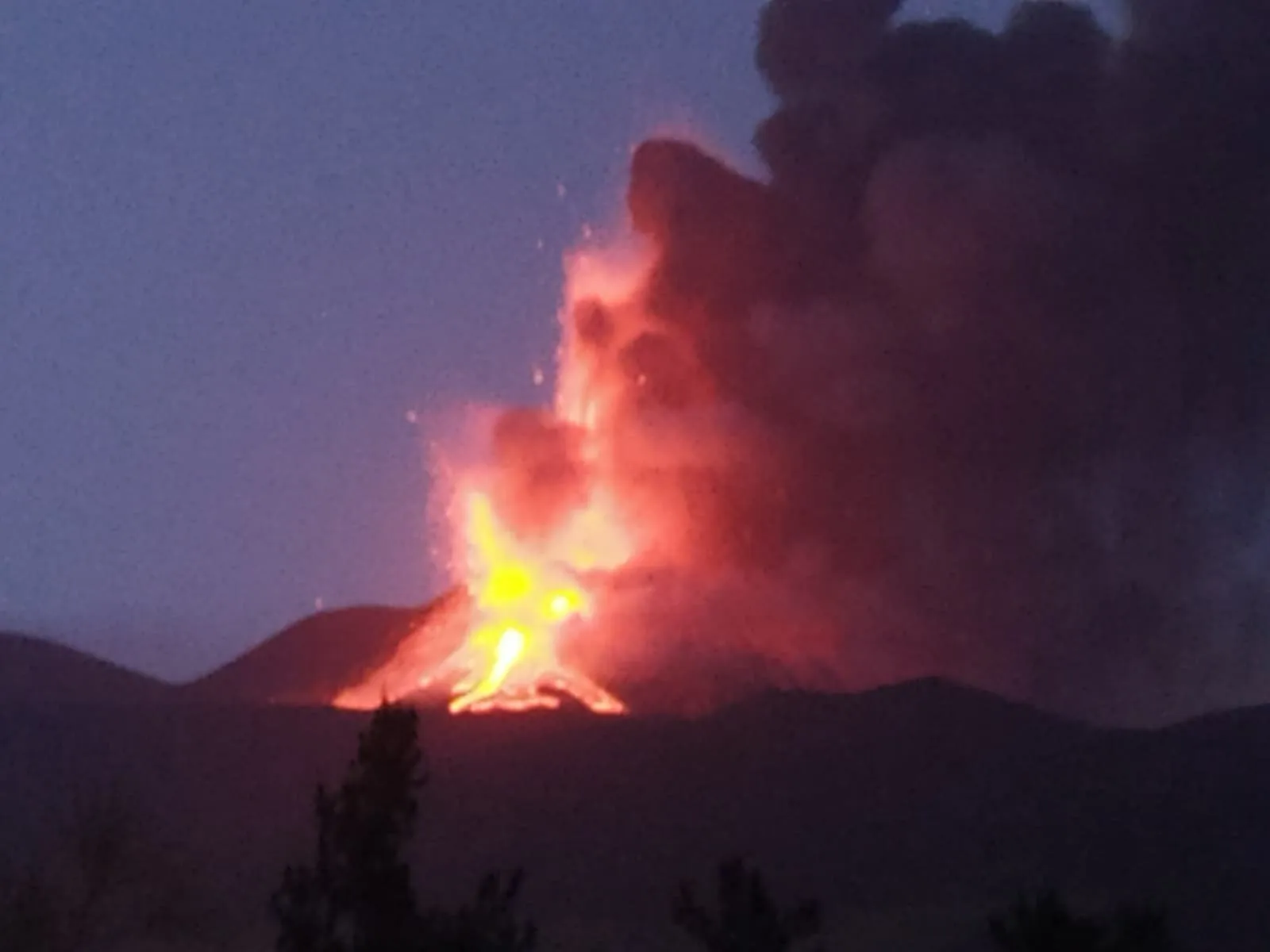
An eruption seen from a distance, with trees in the foreground. Moments like this aren't announced and can't be booked: when the volcano is in this phase, you keep your distance and nobody goes up high.
You rarely see lava, and only when safety conditions allow it. I can't promise it, and be wary of anyone who guarantees it.
Safety gear
We provide the most important part of the gear, and it varies with the excursion. Here's what you get, what it's for and what's left to you.
Trekking and craters
For trekking at 3,000 m and the summit craters, a helmet, hiking shoes, socks, poles and a small backpack are included.
- Helmet: wear it the way you're shown and keep the strap fastened.
- Hiking shoes: on ash and lava stones they hold your feet far better than trainers, especially on the way down.
- Socks: with the right shoes, they help prevent blisters and rubbing.
- Poles: they give you balance on the ash, going up and especially coming down, and take some of the work off your knees.
- Small backpack: for water and your extra layer, so your hands are free for the poles.
The cable car ticket is extra; for the summit craters, so is lunch.
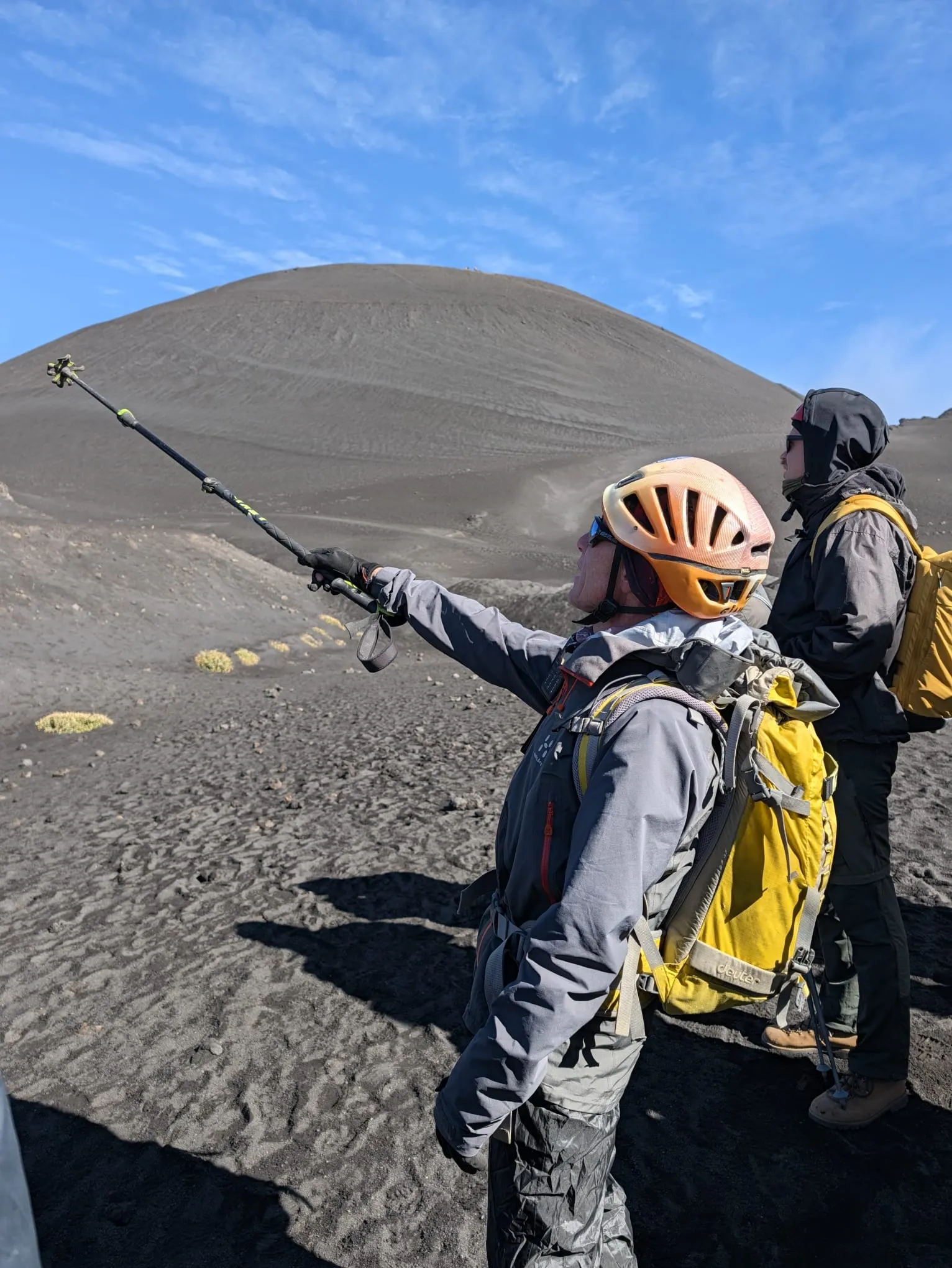
The helmet, poles and backpack are part of the gear we give you for trekking and the craters. Look at the jacket and hood too: even under a blue sky, up high you still wrap up.
Quad
For the quad, a helmet, hygiene cap, windproof jacket and gloves are included. Fuel is included too. The jacket and gloves protect you from the cool air and the volcanic dust.
What you bring
- Long trousers, always: you need them anyway for the quad and the craters.
- Closed-toe shoes for the quad.
- Layers: a light top, a warm layer and a jacket that keeps out the wind.
- Water, even if it's cool.
- Sun cream, sunglasses and a hat.
- In winter: a beanie, gloves for trekking and a waterproof jacket.
- Your usual medication, if you take any.
You'll find it all in detail, season by season, in the guide on what to bring on Etna.
How to behave on the trail
Up high, safety also depends on small things you do yourself. Nothing complicated, but they make a difference.
Follow the instructions
Whoever is leading the group knows the route and keeps an eye on the conditions as you climb. If they ask you to stop, change your pace or turn back, there's a reason, even if you can't see it straight away: follow the instruction, and ask for an explanation afterwards if you like. Remember too that you can only go up on your own as far as a certain altitude: higher up, you can only go accompanied.
Stay on the trail
Off the track, the ash can hide loose stones, holes or spots where hot gas comes out. Staying on the trail, in single file, protects you and the group, and it also respects the volcano's environment. If you need to stop, tell the person next to you instead of falling behind on your own. The same goes for photos: stop in a safe spot and don't wander off for a better shot.
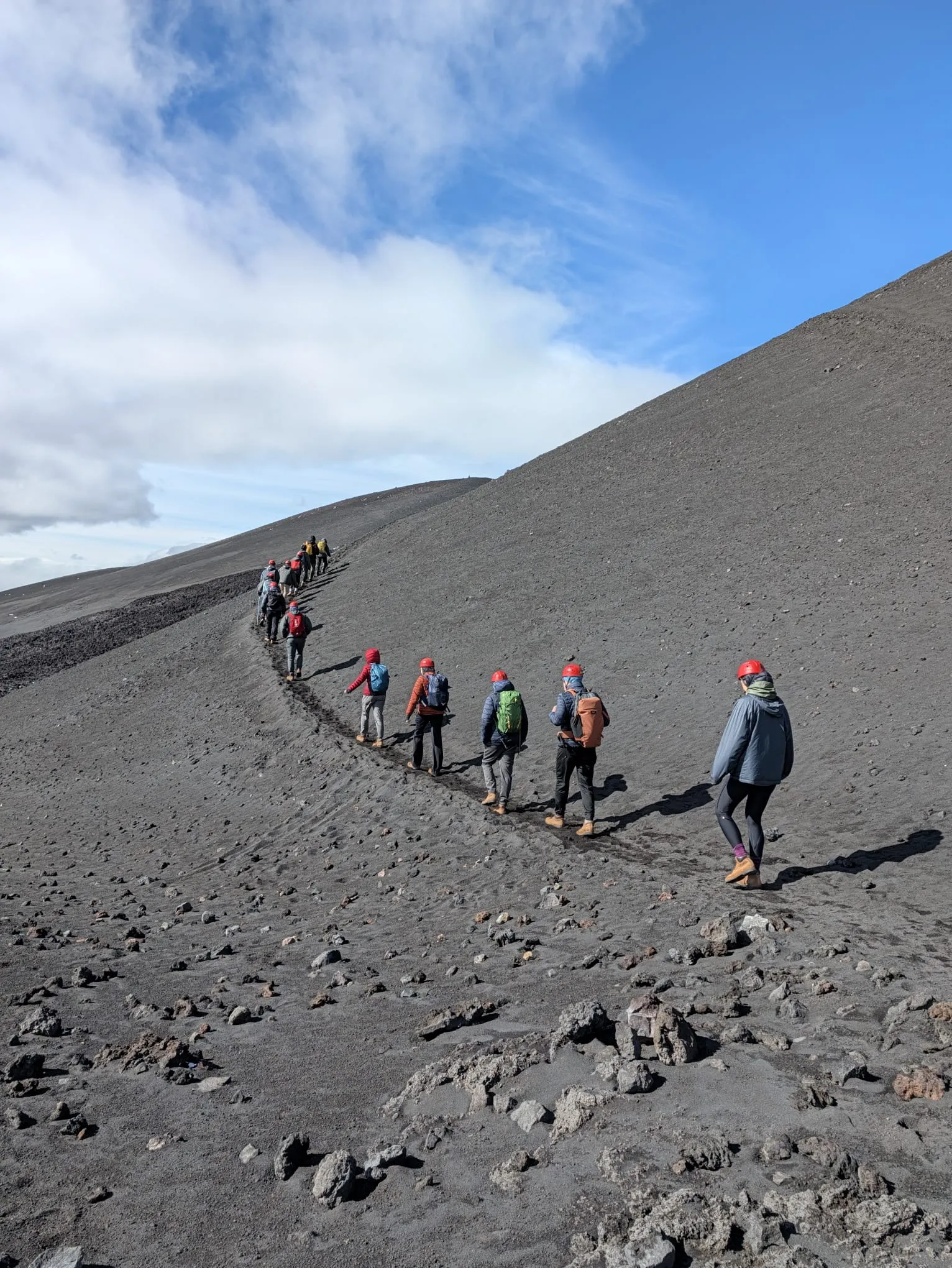
In single file, one behind the other, along the line of the trail: it's the simplest way to walk on ash and keep everyone together.
Drink and eat
The cool air takes away your thirst, but you still feel the effort. Drink in small sips along the way, even if you don't feel the need, and have a proper breakfast before going up. Dehydration, by the way, can cause symptoms similar to altitude sickness: one more reason not to forget your water. For the summit craters lunch isn't included: ask me how to sort it out.
Say so straight away if you don't feel well
This is the most important advice in the whole guide. If you feel something isn't right up high, tell whoever is leading the group straight away, without waiting for it to pass:
- a headache, nausea or dizziness;
- breathlessness that doesn't settle even when you stop;
- a cold you can't shake off;
- tiredness that feels different from usual, or simply the sense that something's wrong.
There's nothing to be embarrassed about. You stop, take stock together and, if need be, head back down. Turning back isn't a defeat: the volcano will still be there.
Riding the quad safely
The questions about the quad are almost always the same: is it safe? Can it tip over? Is it easy to ride? The honest answer is that it's an off-road activity and it needs your attention. You don't need experience, but you do need to respect the vehicle and the instructions you're given.
Before setting off
Before setting off you'll get the gear and all the instructions you need to ride it with confidence. Arrive at the cable car station a little before the agreed time, so there's time to put everything on and listen to the explanations without rushing. If it's your first time on a quad, say so: there's nothing wrong with that, and it's useful to know.
Riding
A few common-sense rules that apply to everyone:
- follow the route and the quad in front of you, with no shortcuts;
- keep a comfortable distance from the person ahead, partly because of the dust;
- adjust your speed to the terrain: on dirt tracks, on bends and downhill, go slowly;
- keep your hands on the handlebars and avoid sudden manoeuvres;
- if something doesn't feel right, slow down, stop in a safe spot and mention it.
The beauty of the quad in the woods is the route, not the speed.
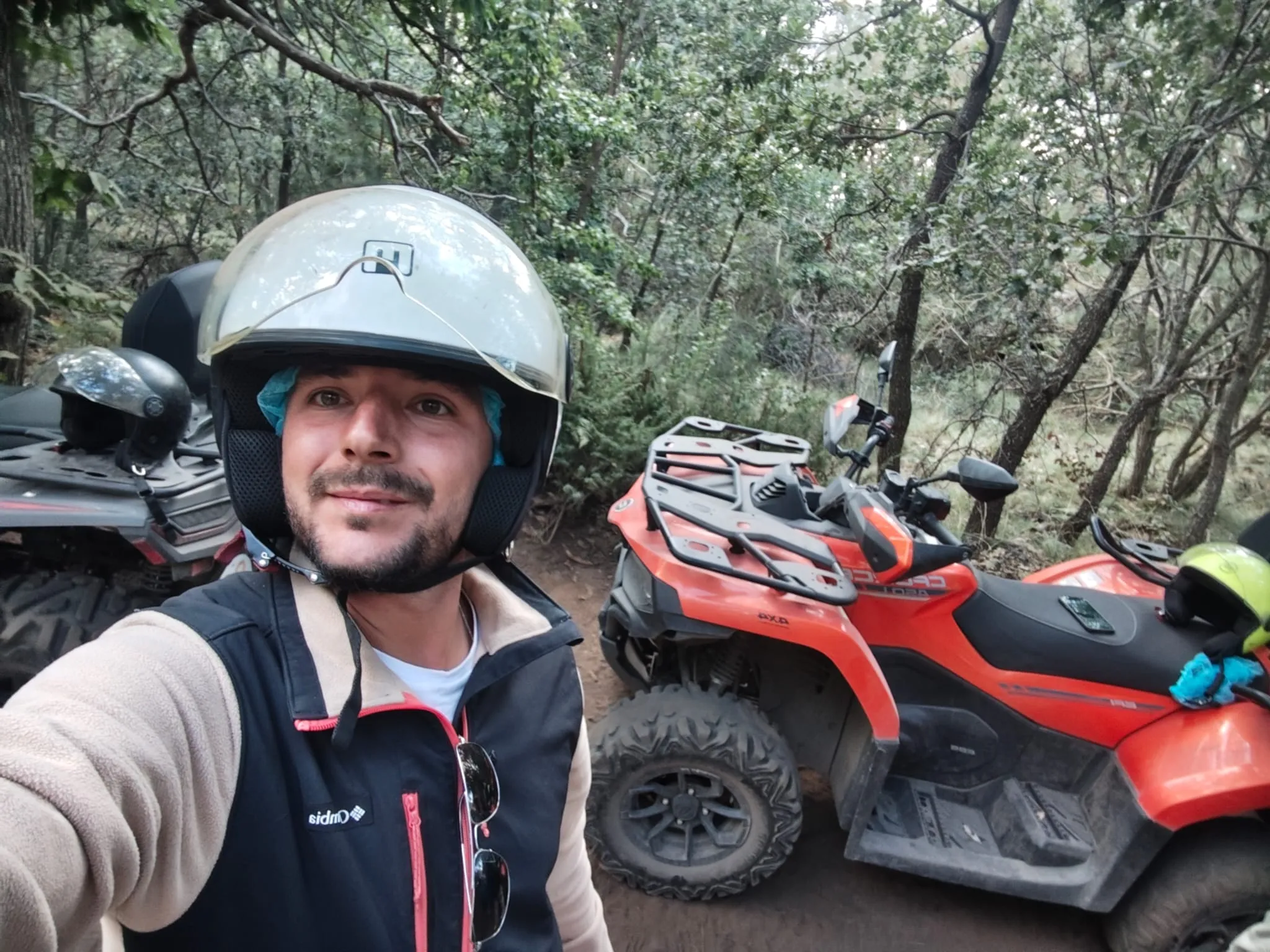
The helmet is included with the quad, as are the hygiene cap, windproof jacket and gloves: you fasten it before setting off and keep it on for the whole ride.
Children, sunset and bad weather
The quad is for ages 6 and up, as long as they're physically up to it and it's safe: when you write to me, tell me each child's age and I'll explain how the ride is organised for your family. It can also be done at sunset, on request, when the season allows; bring an extra layer, because the temperature drops quickly after sunset. With heavy rain, snow on the route or wind, whether to set off is assessed on the day.
If you don't set off, or don't go as high
It happens, and it's part of the volcano. Better to know beforehand, so it doesn't come as a surprise and you can plan around it.
If the conditions aren't right
If the weather or volcanic activity doesn't allow it, the excursion doesn't go ahead. On the day, we'll talk and I'll explain the situation. What I'll never advise you to do is go up high when the conditions aren't right, even if you've travelled a long way to get here. Ask me how a change of date works when you book: I'll tell you straight away, so there are no surprises.
Not going as high
Sometimes you set off but don't reach the planned altitude: because of the wind, the clouds, the volcano's activity, or simply because someone in the group doesn't feel up to it. That's normal. The route adapts to the day, and how far you get is decided along the way, with caution.
Alternatives and a spare day
When going up high isn't possible, the day isn't always lost. Sometimes it's enough to move the time, sometimes it's better to change day, and sometimes it makes sense to choose another excursion: the quad in the woods, which doesn't head towards the summit, is often the simplest one to consider. The full comparison is in the guide quad or trekking.
If you can, don't put the excursion on the last day of your holiday: a free day afterwards gives you the chance to try again instead of giving up. For the summit craters, which depend more on the conditions, that margin matters even more.
My advice
If I had to sum it all up in a few lines: on Etna, safety starts before you set off, with the right choice and a little honesty.
- Tell me everything beforehand: age, fitness and any doubts about your health. If you have heart or breathing problems, trekking and the craters aren't for you: let's look at the quad together.
- Accept that the day decides: weather and volcanic activity are assessed on the spot, on the day. Keep a spare day.
- Up high, listen to others and to yourself: follow the instructions you're given, stay on the trail, drink, and if you don't feel well, say so straight away.
Once that's done, all that's left is to enjoy the volcano. Write to me with how many of you there are, everyone's ages, the day you have in mind and any concerns about health or fitness: I'll tell you honestly which excursion is right for you and send you a quote. You'll find me on the contact page, and there are more quick answers in the frequently asked questions.
Frequently asked questions
Who can't go up to high altitude on Etna?
Anyone with heart or breathing problems, such as asthma: trekking and the craters aren't suitable, and we don't take them up to high altitude, for their own safety. If you have any doubts about your health, write to me first and ask your doctor.
How old do you have to be for the excursions on Etna?
The quad from age 6, trekking at 3,000 m and the summit craters from age 8, as long as they're physically up to it and it's safe. If you're over 65, let's talk first, based on your physical condition.
Is the quad safe? Can it tip over?
It's an off-road activity and it needs your attention. You don't need any experience: before setting off you'll get all the instructions and the gear, that is a helmet, hygiene cap, windproof jacket and gloves.
How do you know if you'll go up high that day?
The conditions on the day tell you: weather and volcanic activity, assessed on the spot that same morning. If the conditions aren't right, the excursion doesn't go ahead, or it doesn't go as high.
Do you get altitude sickness on Etna?
Up high the air is thinner and you get out of breath sooner. Above about 2,400 m some people may get a headache, nausea or unusual tiredness: if that happens, tell whoever is leading the group straight away.
Are the gases from the craters dangerous?
The gases from the fumaroles irritate the airways. That's why you don't go near the fumaroles, you stay on the route and you take the wind into account, as it pushes the gas one way or the other.
Can I go up on my own?
Yes, but only up to a certain altitude. Higher up, you can only go accompanied.
Related excursions
Sources and further reading
- INGV – Etna Observatory (Osservatorio Etneo): monitoring, updates and bulletins on Etna
- INGV – La Geopagina: volcanic fumaroles (in Italian)
- MSD Manual (Consumer Version) – Altitude sickness (in Italian)
- ISS EpiCentro – Ultraviolet radiation (in Italian)
- Meteo.it – Glossary: vertical temperature gradient (in Italian)


